

Have you ever been in this situation?
Where you made an effort to get into bed at the right time so you could get the amount of sleep that you need.
Your alarm goes off. You were asleep during the whole night. You did not wake up once.
And yet, when you get up and make that first movement…
Ouch.
Your back is telling you it is not happy.
You feel the tightness, and it is hard to move.
Or maybe your back feels locked up. Or your neck just does not want to turn. Or it takes minutes, sometimes even hours, to really get the body moving.
Your shoulders already feel like they have gone through a full day, or like they did not get any rest at all.
This can be particularly frustrating, especially when you say to yourself, “What is going on? I did everything right.”
So what gives?
Most people assume that these morning pains are simply a sign of life, or of getting older.
Or they say, “I slept on my neck wrong,” or, “I slept wrong last night.”
And then it becomes something they think they just have to work out as the day goes on.
But those explanations do not really hold up.
Because here is the thing.
If your body is consistently waking up uncomfortable, it is usually not random.
It is a pattern.
And patterns tend to tell us something.
It is probably not just the bed’s fault. It is probably not that you had a bad night of sleep every single night.
There is something more consistent happening beneath the surface.
For many people we see in our clinics, as a chiropractor in Carmel, Indiana, and in Indiana more broadly, this pattern shows up more often than you might expect, and it usually is not random.
Why morning pain shows up even after a full night’s sleep
Let’s start with a simple observation.
Our bodies are not really designed to stay still for six to eight hours straight.
During the day, you are constantly moving, shifting, walking, sitting, standing, bending, reaching, and adjusting your position without even thinking about it.
You are subtly repositioning your body all the time.
At night, all of that slows down.
Now, while sleep is incredibly restorative—and absolutely necessary—there is a tradeoff.
Prolonged stillness.
When the joints of the body do not move for extended periods, they can become stiff. More accurately, they adapt to the position they are held in.
And when that position is held for hours, that adaptation becomes noticeable.
The muscles around those joints can also fatigue.
And when pressure is applied to certain areas for long periods—like when you are lying on them—the tissues can become irritated.
That alone explains some of the stiffness you feel in the morning.
But it does not explain why some people wake up feeling fine, while others feel like they aged ten years overnight.
That is where your spine comes in.
Your spine does not turn off when you sleep
Even though you are resting, your body is still under load.
Gravity does not turn off when you sleep.
It is still acting on your body.
Which means your spine is still supporting you.
Your joints are still under pressure.
Your muscles are still working, even if only subtly, to maintain your position.
The difference is this:
You are not correcting anything.
During the day, if you sit poorly, your body eventually shifts. You stand up. You stretch. You move.
At night, if you are in a less-than-ideal position, you stay there.
For hours.
And that is where small issues can quietly become bigger ones.
Small problems plus time equals noticeable pain
Most morning pain is not caused by one major event.
It is usually the result of small stresses applied over long periods.
Maybe a slightly rotated pelvis.
Maybe your neck is angled by your pillow.
Maybe your shoulder is compressed under your body.
Individually, these are not dramatic.
But over six to eight hours, they add up.
It is like holding a light weight.
For a few seconds, no problem.
For several minutes, you start to feel it.
For hours, it becomes uncomfortable.
Your body experiences something similar during the night.
And when you wake up, you feel the result.
How spinal alignment affects your sleep
Your spine is not just a stack of bones.
It is a dynamic system that distributes load and allows movement while protecting your nervous system.
When it is in a more neutral position, forces distribute evenly.
When it is not, certain areas take on more stress.
And because you are not moving during sleep, those stresses accumulate.
If your low back is arched or flattened for hours…
If your neck is angled due to pillow height…
If your shoulders are rolled forward or compressed…
Your body adapts to that position.
That adaptation shows up as stiffness, tightness, and reduced motion.
And unfortunately, it can all happen before your day even begins.
This is one reason chiropractic approaches to back pain often focus on how your body behaves over time, not just how it feels in the moment.
The hidden role of sleep posture
Most people fall into one of three categories:
Side sleepers, back sleepers, or stomach sleepers.
Each has pros and cons.
- Side sleeping – This is very common and often a good option. But if your hips collapse, your top leg rotates forward, or your shoulders roll inward, you can create twisting forces through your spine. Over time, that can lead to low back stiffness, hip tightness, and shoulder discomfort.
- Back sleeping – This position tends to distribute weight more evenly. But it is not perfect. If your pillow is too high, your neck is pushed forward. If it is too flat, your neck extends backward. If your low back is unsupported, it may arch excessively. All of that can contribute to stiffness and discomfort.
- Stomach sleeping – This is more controversial. Done correctly, it can be supportive. But most people do not support it correctly. It forces the neck into rotation for hours. That alone can create strain. Add pressure on the low back, and it is not surprising that many stomach sleepers wake up sore. It is common for people looking for a chiropractor for lower back pain or neck pain to realize their sleep position has been contributing more than they thought.
Your mattress and pillow may also be part of the problem
Even with good positioning, your setup matters.
Mattress
A mattress that is too soft can allow your body to sink unevenly.
Some memory foam mattresses may feel comfortable initially but promote poor positioning over time.
You want support.
Enough give to be comfortable, but not so much that your body collapses.
Often, starting with a more supportive or firmer option is helpful.
Pillow
Pillows are often overlooked.
If your pillow is too high, your neck is angled.
If it is too low, your head drops.
Either way, your spine is no longer neutral.
And over several hours, that matters.
So what is morning pain trying to tell you?
Morning pain is not just something to get rid of.
It is information.
It tells you where stress is accumulating.
It reflects how your body responds to your sleep positions.
For example:
- Low back symptoms that improve quickly may relate to positioning.
- Neck pain may suggest pillow or alignment issues.
- Shoulder discomfort may be pressure-related.
The goal is not to overanalyze every sensation.
But to notice patterns.
Because patterns point to causes.
How to relieve morning back pain
If you are waking up with pain, what can you do?
Many people searching for a chiropractor in Indiana or a chiropractor in Carmel, Indiana are dealing with this exact issue.
Start simple.
Move.
Not aggressively. Not forcefully. Just gently.
Walking, light stretching, and controlled movement can help restore motion.
If you sit for long periods during the day, break that up.
Set a timer.
Move regularly.
Heat can also help relax muscles.
A warm shower before bed or in the morning can make a difference.
Be cautious about overcorrecting.
Trying to aggressively stretch everything at once can make things worse.
Your body does not need to be forced.
It needs to be guided.
How to stop morning pain from coming back
Relief is one thing.
Prevention is another.
Improve your sleep position
Small changes can make a big difference.
For side sleepers:
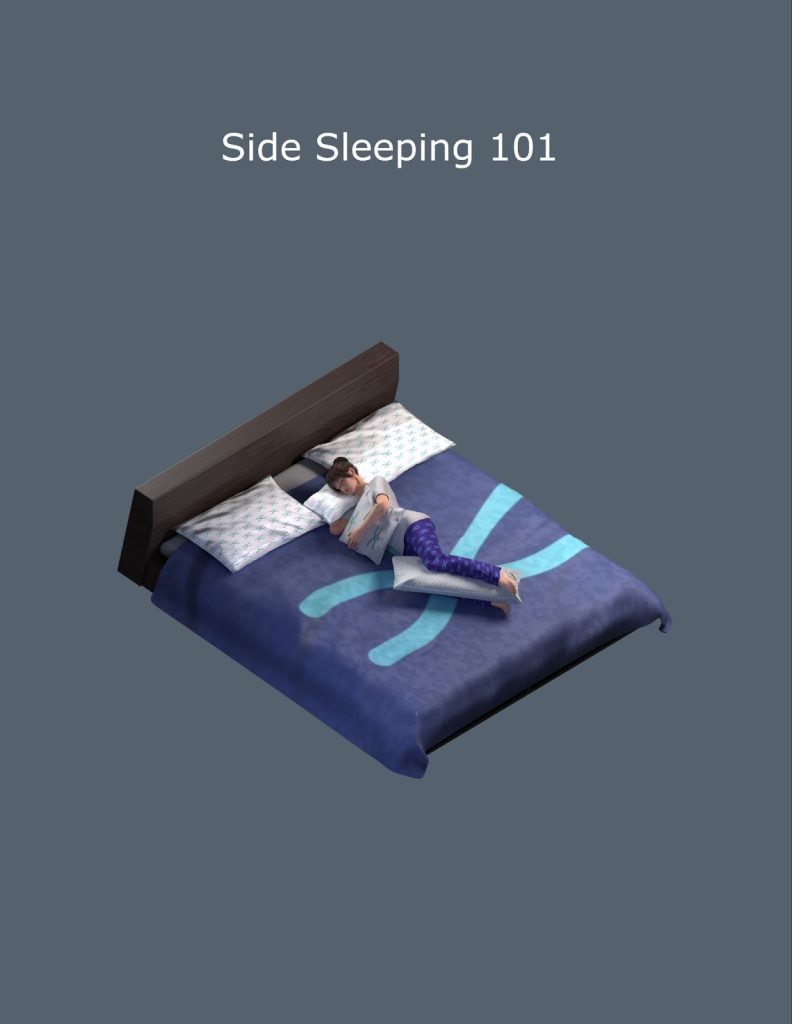
- Use a pillow thick enough to support your head. Make sure that your pillow is placed above your shoulder and that it keeps your neck parallel to the bed.
- Place a pillow between your knees and ankles.
- Support your top arm to prevent rotation by placing a pillow under it
For back sleepers:
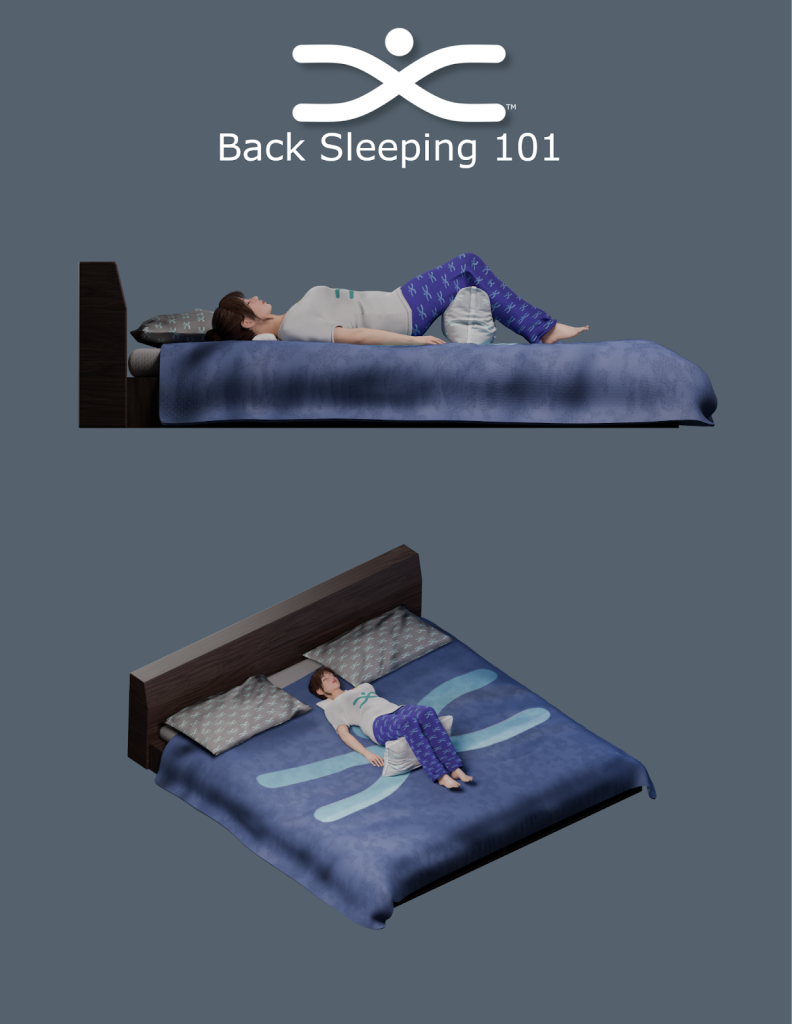
- Use a pillow that supports the natural curve of your neck. Something rolled up is pretty good.
- Place a pillow under your knees so that they are elevated like 1-2 feet above the bed.
For stomach sleepers:
- Only continue if you can support it properly. This means if you can get a “U”-shaped pillow so that your head can rest looking down in it with a pillow beneath the stomach and pelvis and a pillow propping up the feet in the back.
- Use specific positioning to reduce strain. However, the concern comes in of potential suffocation if your head shifts to one side or the head space isn’t wide enough. If that can be avoided stomach sleeping can actually be the best position for the spine.
Evaluate your mattress realistically
If your mattress is very old, it may be time to evaluate it.
But if your pain is recent, it is often not just the mattress.
It is usually how your daily habits interact with your sleep.
Be consistent
This is where most people struggle.
They try something once and expect immediate results.
Your body adapts over time.
Consistency matters more than perfection
How we evaluate sleep positions and spinal stress
In practice, whether someone visits a chiropractor in Fishers, Indiana, Carmel, or elsewhere, patterns often emerge that are not obvious at first.
What feels comfortable is not always what is supportive.
A structured evaluation looks at:
- Positioning
- Pressure points
- Joint response over time
This is especially important for those recovering from injuries, including auto accidents.
Sometimes morning discomfort becomes more noticeable during recovery.
The goal is not to complicate things.
It is to simplify them.
We here at Integrated Health Solutions specialize in identifying these patterns, which enable us to create a solution for our patients that helps them with solutions for their present symptoms and enables them to maintain their solutions in the long term.
The bigger picture: your body is talking
Are you listening?
It is easy to dismiss morning pain.
To blame stress, age, or a random night.
But when it keeps happening, it is not random.
It is your body adapting.
And adaptation leaves clues.
The good news is that most of the time, these issues are mechanical.
And mechanical problems often respond to mechanical solutions.
Better positioning.
Better support.
Better awareness.
And consistency.
Final thought: waking up should not hurt
You should not have to warm up just to feel normal.
You should not dread that first movement.
And you should not assume this is just how things are now.
Because in many cases, it does not have to be.
If your mornings consistently start with stiffness or discomfort, it may be worth taking a closer look at what your body is experiencing overnight.
Sometimes a few small changes can make a meaningful difference.
And sometimes a more guided evaluation can help connect the dots.
Whether you are exploring options with a chiropractor in Carmel, Indiana, chiropractors in Fishers, Indiana, or an Indianapolis chiropractor, the goal is the same:
Help your body rest in a way that actually restores it.
Because sleep should leave you feeling better, not worse.
Content Provided By Dr. Andrew Sanders