
So, you signed up for a 5K, and you are fired up about it. Week one feels great, but by week two, the shins start talking. By week three you’re Googling “shin splint pain running” at 11pm and trying to figure out whether you need to push through it or whether something is actually wrong.
I see this in my office weekly, and almost all of it is preventable. Just by understanding what’s happening in your body when you run, and dealing with the weak links before they snap. An ounce of prevention can be worth a pound of cure.
Running Is a One-Legged Sport
Here’s something that surprises almost everyone I explain it to: running is not a two-legged activity. Every stride, your entire body weight lands on one foot. You push yourself forward and then you catch yourself on the other foot. This is very evident if you have ever watched a baby learning to walk! Over and over, hundreds of times per mile. Every time your foot hits the ground, the force going through your leg is approximately two to three times your body weight. At 160 pounds, that’s somewhere around 320 to 480 pounds of force per step.
That number sounds alarming but it shouldn’t be. An in balance body can handle it just fine. The problem is that “everything working right” is a higher bar than most new runners account for. Your heart and lungs might be ready to run for twenty minutes. However, your tendons and joints and all the stabilizers muscles that keep you moving the way you are supposed to will not be ready yet. They take more time to be ready for increased load. What starts as tension and soreness turns into strains, muscle pulls, and inflamed joints.
Some call this the fitness-resilience gap. You feel fine during the run. Cardiovascularly, you are fine. But you’re slowly stacking more stress on your tissues than they can recover from between sessions. The injury doesn’t happen during the run where you finally feel it. It started accumulating two weeks ago. You just didn’t know.
At Integrated Health Solutions, we use Dynamic Neuromuscular Stabilization (DNS) as part of our diagnostic exam to determine if you are moving in the ‘ideal’ way. The way that puts the least stress on your tissues. DNS is based on the developmental movement patterns every human goes through as a baby in the first year of life. So, rolling over, pushing up. Crawling, and up to standing. Those early patterns are part of your deep stabilization system — the diaphragm, pelvic floor, deep spinal muscles, the whole internal pressure system that everything else in the body is built on top of. When that is moving and being used ideally, the forces of running are able to distribute well. When it doesn’t, other structures are forced to pick up the slack. Those compensations, combined with repetition, turn into injuries.
The Injuries I See The Most
The injuries that bring new runners into my office are not usually random. They follow patterns that can often be predicted based on movement patterns and what muscles are activating as they should, and which ones are not.
For example, shin splints are a very frequent complaint. Then entail pain along the inside edge of the shinbone/tibia. They often begin as dull pain or tension, but become sharp when you keep running on them. Very often this is caused by weakness in the hip and stiffness in the ankle. It is a small thing, but hitting the ground over and over again will cause pain further up the leg.
Similarly, IT band syndrome can begin as sharp pain on the outside of the knee. Everyone wants to foam roll it, but the band is not the problem. The problem is the gluteus medius not keeping the pelvis level. Every step, the hip drops a little to the unsupported side. You’d never notice it in a mirror. But the IT band drags across the lateral knee, and a few miles of that gives you a very angry knee.
Plantar fasciitis is that first-thing-in-the-morning heel pain where it feels like someone shoved a hot poker into the bottom of your foot. The fascia tightens overnight, those first steps out of bed stretch it hard. Almost always about calf tightness and weak arch musculature — not the shoe, the muscles. A tight calf is like a door that only opens halfway. The ankle can’t get the range it needs, so the arch collapses to compensate. The plantar fascia pays for it.
Achilles tendinopathy — pain and stiffness at the back of the heel, worst when you first start moving, sometimes easing up once you’re warm. New runners make a dangerous assumption here: “It feels better once I get going, so I’m fine.” No. Tendons adapt on a much slower timeline than muscles. We’re talking weeks to months. That easing-off sensation is the tendon getting warm and pliable. Not healing. Just warm.
Runner’s knee, that achy, sometimes grating feeling around the kneecap. It is often worse going downstairs and worse after sitting for a long time. When quadricep strength is out of balance or the hip isn’t stabilizing, the kneecap drifts and grinds against the side of the femur.
All of these, at root, are coordination and loading problems. And they are not only fixable, they are preventable.
What We Actually Do in the Clinic
A lot of running injury advice focuses on stretching and proper rest. These are important, but without making sure your movement patterns are correct, the issue will keep returning as soon as you return to activity.
We evaluate these with movement screens built into our regular examinations. We watch how you squat, walk, and stand on one leg. We also perform orthopedic tests and range of motion tests, but these often catch problems once they are already causing pain. The movement assessments can catch issues BEFORE they turn into painful problems. The most important functions are the ability to keep a neutral spine, while breathing into your belly. That is foundational to all human movement and one of the major things we check for. If that is incorrect, many other patterns will suffer and cause extra tension and pain.
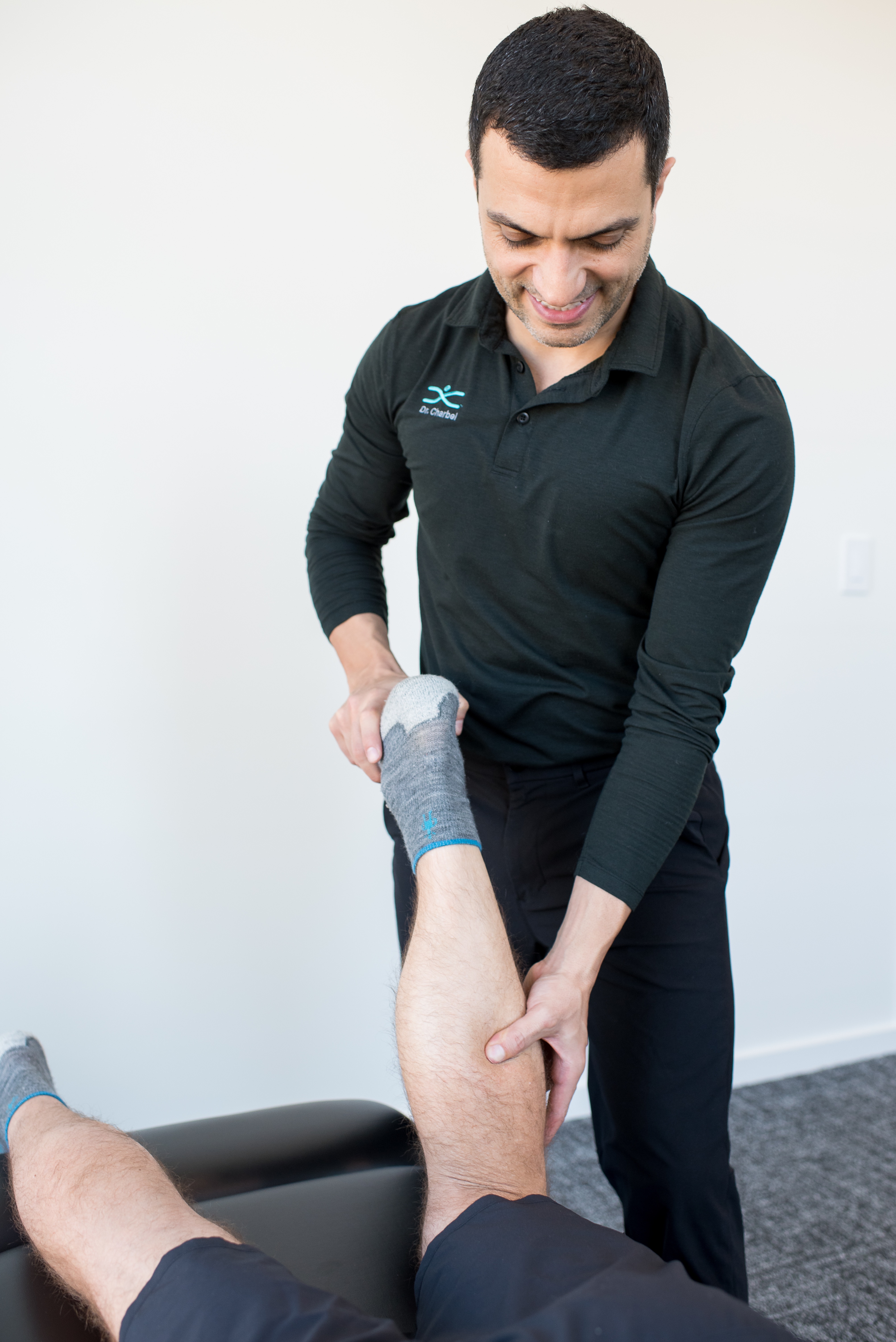
We then create a treatment plan around returning the movement or improving the pattern that is not correct. We do this in several ways. We use dry needling to relax trigger points in dysfunctional muscle tissue. This both relaxes muscles that are too tight and tense, and activates muscles that are not pulling their weight and firing when they are supposed to. We often combine this with tens to enhance and speed up results. This also has a neurological effect and can help the brain tell the muscles to relax as well.
We also adjust joints that are restricted, or not displaying as much mobility as they should be. This also has a neurological effect and can immediately change how you can move and what muscles are able to activate. Adjustments restore normal joint motion and help the feedback that goes back to the brain as well. This helps you ‘feel’ where you are in space better and helps your body stabilize itself properly.
We use soft tissue work, either by hand or using an instrument to release tight tissues. This works great as an adjunct to the other therapies and also for areas that we do not dry needle.
Most importantly, we give at home functional exercises that retrain the correct movement pattern. This is how we get better and more longer lasting results. The exercises advance over time just like a baby in the first year and get progressively more functional. These are not just stretches and simple exercises, they integrate breathing and bracing into every movement. This is different from traditional exercises that isolate specific muscles and train them on their own. The exercises are necessarily hard, but they often require thought. Like rubbing your stomach and patting your head at the same time. They change how your nervous system chooses which muscle to fire and when and can return you to ‘idea’ patterns.
Sarah’s Shin Splints: A Real Case
A patient came in with chronic calf tension. She was a cross country runner, but her calves kept getting tight no matter how much training she did. During examination, she had increased tension in her lower back, hamstrings and calves. They were all overloaded. The reason was because she lacked proper core stability. She had trouble using her diaphragm to breathe properly and as a result her lower back was not stable. Therefore all the muscles of her leg had to pull harder to move her forward since they were pulling on an unstable base of support.
We worked on integrating her breathing and core activation through exercises from on the ground up to standing which resulted in her calf pain resolving. Additionally, her speed increased and she had better times than before!
What You Can Do Right Now
Not everyone reading needs to begin a treatment plan, but there are a few things you can start doing today that will genuinely help.
Learn to breathe properly. Lie on your back, knees bent. One hand on your chest, one on your belly. Breathe in. If the chest hand moves more than the belly hand, that’s a problem. Practice 360-degree expansion — belly, flanks, lower back all expanding on the inhale. This is the basis of all movement, you have to get this right first.
Test your single-leg stability. Stand on one foot, eyes open, 30 seconds. Then close your eyes. Notice if the hip drops. Notice if the foot rolls in. Notice if you’re gripping the floor with your toes like you’re hanging on for dear life. Whatever you see standing still will be amplified at speed.
There is a 10% rule for training at running. Don’t increase weekly mileage by more than 10%. Your cardiovascular fitness will outpace your tissue resilience every single time. This rule gives your tendons and bones time to catch up with your lungs so you are not overtraining.
Know the difference between fatigue and pain. Muscle fatigue during a run is normal. Joint or tendon pain is not. Anything that lingers more than an hour after you stop is your body asking for help. Deal with it early and it goes away fast. Ignore it and you’re looking at weeks or months instead of days.
Bottom Line
Running can be a phenomenal stress reliever and physically be really great for you. It can benefit your cardiovascular health, mental health, and even bone density.
But it is a skill, not just cardio. It needs a foundation: stable joints, muscles that coordinate under load, breathing that supports stabilization instead of fighting it, and tissue that can handle the repetitive stress. Most people haven’t trained any of that. Building it doesn’t take forever and you don’t have to become a gym person. You just have to pay attention to how your body moves, and be willing to deal with the small stuff before it becomes the big stuff.
If something keeps getting tight or stiff no matter what you do, stop in and see someone. Don’t wait for it to turn into an injury. The goal isn’t just crossing the finish line. It’s making sure your body is in better shape at the end of training than it was at the start.
Content Provided By: Dr. Elizabeth Bouse
Sources
- Hreljac A. Etiology, prevention, and early intervention of overuse injuries in runners. Phys Med Rehabil Clin N Am. 2005;16(3):651-667.
- Lopes AD, et al. What are the main running-related musculoskeletal injuries? A systematic review. Sports Med. 2012;42(10):891-905.
- Nielsen RO, et al. Training errors and running related injuries: a systematic review. Int J Sports Phys Ther. 2012;7(1):58-75.
- Heiderscheit BC, et al. Effects of step rate manipulation on joint mechanics during running. Med Sci Sports Exerc. 2011;43(2):296-302.
- Alfredson H, et al. Heavy-load eccentric calf muscle training for chronic Achilles tendinosis. Am J Sports Med. 1998;26(3):360-366.
- Kolar P, et al. Postural function of the diaphragm in persons with and without chronic low back pain. J Orthop Sports Phys Ther. 2012;42(4):352-362.
- Harvard Health Publishing. Running injuries: how to treat and prevent them.