
Chiropractic care does not end when you leave the office. What you do between visits plays a major role in how well your body adapts, recovers, and maintains progress. The At-Home Recovery Kit is something you can put together yourself and is designed to help patients actively support their recovery in a safe, structured, and intentional way. Most of us have lives and jobs that consist of repetitive type motions. The effects of these motions accumulate and can cause larger problems over time. Problems such as tension, lack of mobility, pain, spasms, and even muscle inactivation. Think of this like a first aid box at home. The difference being, in addition to injuries and flare ups- this can be beneficial for weekly and more often use as well. This blog will go over items you can put in your kit, what they can help with and how to use them. Remember, an ounce of prevention is worth a pound of cure!
Why an At-Home Recovery Kit Matters
Daily stresses and repetitive patterns can take a toll on the body that is not noticed until they have created more changes than realized. Having a plan for helping yourself at home BEFORE a flare up or injury happens is invaluable. Even more importantly, using some of these tools at home can help avoid issues in the first place. Muscles, fascia, and the nervous system respond to daily stress, posture, and movement patterns. Without reinforcement between visits, progress can stall or regress. Consistent at-home care improves the durability of care. In addition to being really helpful to maintain feeling your best between visits. These steps and having the right equipment at home can help you help yourself in the event of a new pain or tension. You may be able to fully address it at home, or at least improve how you feel right away. It is always better to have a plan or even just a plan B when unexpected injuries arise.
What the At-Home Recovery Kit Is — and Is Not
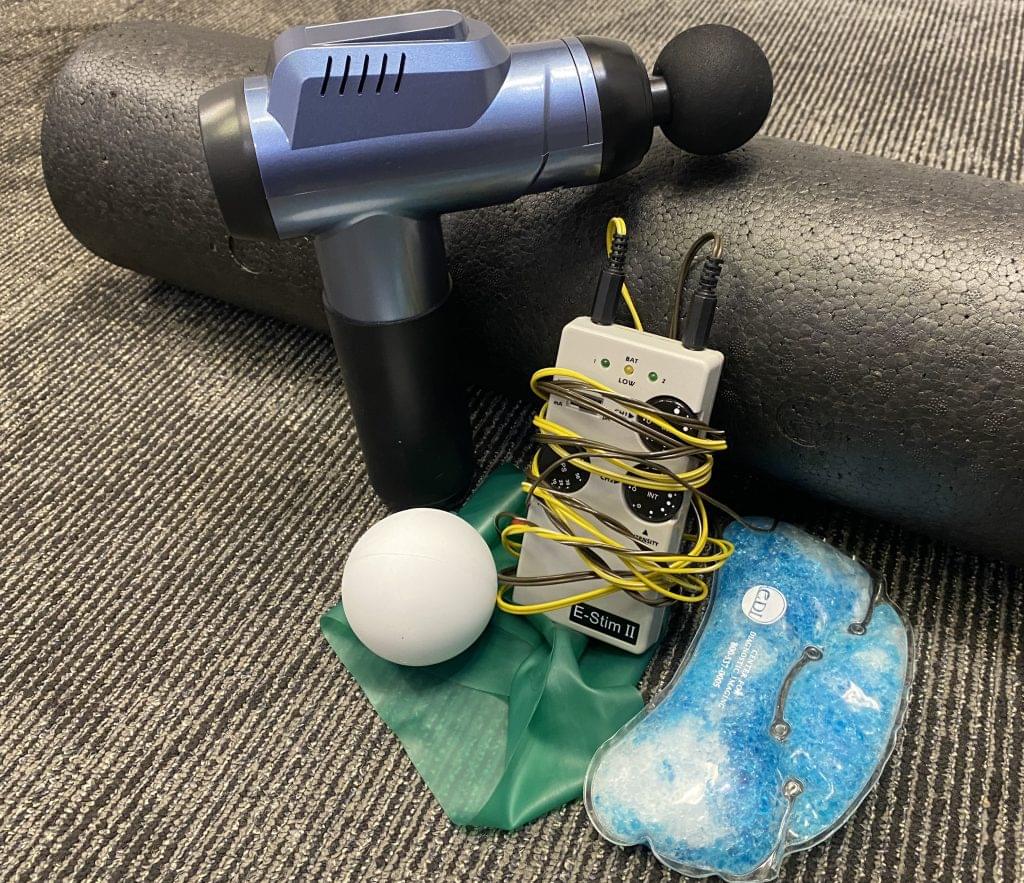
The At-Home Recovery Kit is a collection of simple tools and tricks that support mobility, tissue health, and comfort between visits. They are relatively inexpensive and easy to store and even keep on your person for use at work or on trips. They make great gifts for loved ones and friends! Utilizing this for yourself can make a big difference over time, not only in how you feel, but also in your susceptibility to injury and effectiveness of any workouts or rehab you may be doing elsewhere.
However, these are not a substitute for professional evaluation, diagnosis, or treatment. All tools should be used with intention, moderation, and safety in mind.
Core Components of the At-Home Recovery Kit
Lacrosse Ball or Trigger Point Ball
I love these! They are inexpensive and last forever. You can also use a tennis ball, if that is what you have, but they are not quite as aggressive as a lacrosse ball and thus don’t work quite as well. Use for localized myofascial release in areas such as the glutes, upper back, hips, and feet. Pressure should be controlled and paired with slow breathing. This is a fantastic way to both work out trigger points and tension, as well as activate muscles prior to using them. For example, rolling out the top of your glutes prior to performing squats or a run, will help you activate them more correctly. This is especially true if you sit a great portion of the day. There are numerous videos online with trigger point balls being used for various muscle tensions. We also have some on our channel: https://www.youtube.com/@ihsindy
Foam Roller
Foam rollers are fantastic for adding motion to the mid back as well as working out tight tissue in the quadriceps and hamstrings. Supports global tissue mobility and circulation. Avoid aggressive rolling and rolling the low back. These can be used to roll out IT bands as well as the back of the shoulder. The can be laid on ‘long ways’ and used to stretch the chest, or even rolled across the back while bridging the hips up to mobilize the mid back. There are thousands of YouTube videos on all the various ways to use foam rollers to increase mobility. Check out our YouTube channel for some from IHS. https://www.youtube.com/@ihsindy
TENS Unit
These units have been around for decades and are very helpful for pain modulation and muscle relaxation. They can be found for sale online and with leads that go to stickers that can be placed on 2 places on the same muscle. The current is slowly increased and should remain comfortable. They work well for increasing muscular relaxation and increasing blood flow. They are usually used for about 30 minutes, but can be worn for longer. They are most often used on the neck, upper back, and lower back.
Follow recommended placement, duration, and frequency guidelines. They do have some contraindications. Do not use it across the chest, during pregnancy or if you have a pacemaker. Please do not put these on your head either. They are available online for around $30 and the stickers will need to be replaced periodically.
Stretch Strap or Resistance Band
Resistance bands and yoga- like stretching straps are great for getting more out of exercises and stretches. They help with controlled, assisted stretching without overstretching and are commonly used for the neck, hips, and hamstrings. The resistance bands only last a few years before getting brittle and need to be replaced every 3-4 years. In addition to helping with stretching, they are excellent at increasing the load of various exercises and can be stepped up in intensity with various resistance levels available. This way you can increase the load over time and make each exercise more challenging before moving on to the next more difficult exercise. These can be loops or long straps depending on the exercise and what is needed. I prefer the longer straps as they can be used long or knotted to make a loop. These are available absolutely everywhere, from Amazon to CVS and often come in packs of various resistance levels.
Heat and Cold Therapy
Icing and heating an injury is a question I am asked a lot in the clinic. Unfortunately, doing what feels better is not always the right answer. In general, heat is a better option as it increases blood flow and will speed healing. However, in acute injuries, injuries with bruising or swelling, or higher level pain, cold therapy is a better plan. Basically, heat supports muscle relaxation and stiffness reduction. Cold is best for acute inflammation or flare-ups. Gel packs that you can get online are the easiest choice as they can be heated or cooled in the freezer for use in both situations. Additionally, fabric full of rice can be purchased and can be microwaved for moister heat. These are easy to keep on hand and helpful to already have before they are needed.
Massage Gun or Percussive/Vibrational Instrument
These have become very popular over the last 5 years and can range from $30-$350. They use percussion and vibration to increase blood flow, stimulate lymphatic movement and work on relaxing muscle tension and fascial tension. They can be used over clothing and are very effective with relieving tension. However, they can be overused. Ideally, you will be working in the area of tension for around 5 minutes. Do not go much over that as you can cause more inflammation and significant soreness later.
Golf Ball
These are very easy to find and if you don’t already have one, you can probably get one from a neighbor! Golf balls are perfect for working the bottom of the feet if you have tension there. In the clinic, I usually recommend these for plantar fasciitis to get more relaxation of that tissue at home. They can even be kept in the freezer so you are getting cold therapy and fascial release at the same time!
How to Use the Kit Effectively
Since many of these items can be used in a myriad of ways, how you use them will depend on the particular issues and tension that you may be having. If you have a Chiropractor, Physical Therapist, or Massage Therapist, you can ask them if they have suggestions for your specific case. In general, short, consistent sessions are more effective than occasional intense use. Ten to fifteen minutes per day is sufficient for most patients. All tools should be paired with relaxed breathing and body awareness. It is possible to have muscle soreness with overuse, so take it easy beginning with shorter 5 minute sessions and moving up to 10-15 minutes. These modalities dovetail really well with stretching and a regular exercise program. If you are currently in rehab therapy for an issue, they should help you progress more quickly. Most of these tools are also small and mobile, so don’t forget to take them to work or on vacation with you if you think you may need them.
Common Mistakes to Avoid
The most common mistakes I see include using excessive pressure, chasing pain instead of improving movement and mobility, and ignoring symptoms that worsen or change over time. Pain is not in fact weakness leaving the body. If something is hurting, stop doing it. If you feel like you are back to where you started as far as stretching after every session, there is most likely something you are missing. Basically, if you feel the need to stretch or massage the same muscle daily for weeks, then something else that needs to be addressed. If you are on the right track, you should be improving over time! If you are not, seeing a professional can save you time by highlighting which areas you should be working on and adding the techniques and treatment you cannot do yourself.
When to Pause and Consult Your Chiropractor
Absolutely see a professional if your symptoms are not improving or are consistently recurring. Also if you have new or worsening pain, numbness or tingling, sharp or radiating pain, or symptoms that do not improve with conservative at home treatment.
The At-Home Recovery Kit empowers patients to actively support their care between visits and be their own sort of first line of defense. In addition, consistent and intentional use helps maintain progress, build long-term mobility and create good fascial and muscular mobility. These tools can help maintain mobility with a repetitive job, support strength or other gains, address muscle pain at home, and even improve mobility over time. It is a nice feeling being able to help yourself and knowing how to take care of small exacerbations and flare ups at home. Use these wisely and have fun helping yourself!
Content provided by Dr. Elizabeth Bouse