
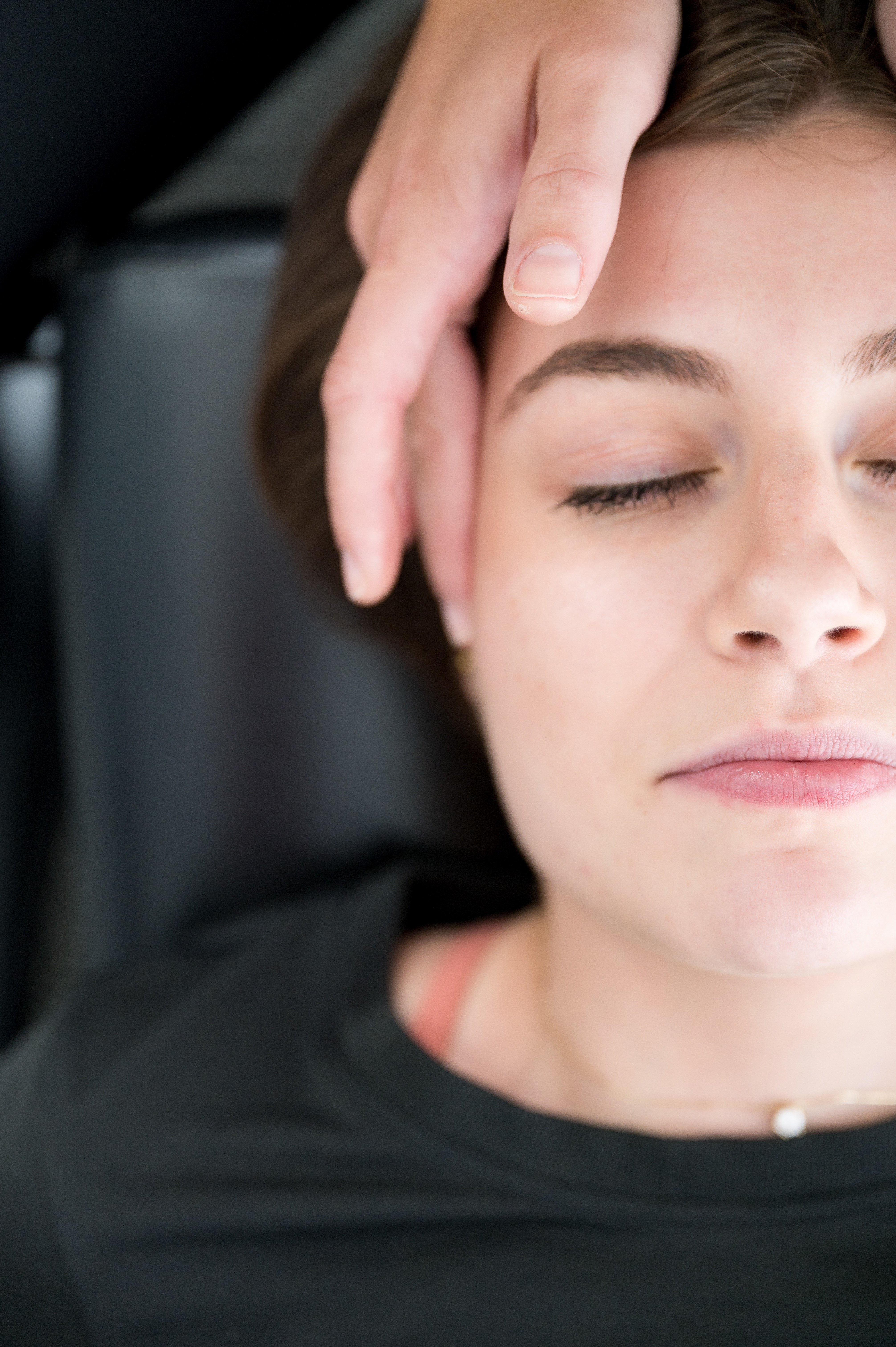
Chronic headaches and migraines are a very common reason people seek Chiropractic care. Often the words are used interchangeably with ‘migraine’ being used to mean a very severe headache, or a headache with an aura or nausea. However, getting the correct label is extremely important as it can change treatment and even the type of doctor it is best to see. Headaches and migraines affect around 40 million Americans each year. Around 8 million people go their doctor each year for treatment. They affect women more than men and are also seen more often in younger adults compared to older adults. It is also common to have them ‘run in families.’ They can be very debilitating and cause people to withdraw from family, friends, and hobbies, as well as miss time from work or school.
The drivers of headaches and migraines are very diverse and can include work postures, diet, screen time, stress, sleep posture, blood pressure, and even changes in the weather! The goal today is to understand the differences between the two, explain triggers and why they can occur, give some possible treatments for several types, and to highlight when medical referral is needed. As a rehabilitative chiropractor, I focus on movement, function, myofascial tension and how to have a lasting outcome. Conservative care such as soft tissue work, dry needling, adjustments, and needed functional rehabilitation can reduce and eliminate many of the types of headaches and migraines that we will talk about.
GETTING THE DIAGNOSIS RIGHT
The word ‘headache’ is a general term or category and not an actual diagnosis. There are many different types of headaches and treatment can vary depending on the cause of the pain. The common types are tension headaches, cluster headaches, and migraines. Headaches and migraines can also be caused by various diseases, reduction of caffeine, or medication changes. For this reason, headache journals are so useful as you can use them to track foods, stress, and lifestyle around your headaches in order to help figure out the triggers. Do you get them only in the morning or afternoon? Following a meal, or only during the work week? These are clues that can lead to fixing the problem more quickly and completely. Figuring out the exact reason or reasons is key to long term improvement! The more information you can give your provider, the better they will be able to help you. Most examinations will begin with a very thorough history and a movement-based exam. These will be used to identify triggers, and also to rule out cervicogenic headaches that are caused by tensions and fixations in the neck. Often the TMJ is also assessed to make sure clenching the teeth or bruxism is not an issue.
TENSION-TYPE HEADACHES: OFTEN MUSCULOSKELETAL
Tension type headaches are typically described as dull and aching sometimes with the pressure that wraps around the head and is commonly called a band type feeling. They are more typically mild to moderate in intensity and can last a short period of time to several days. They can be bilateral or unilateral but are usually on both sides and can be anywhere from the back of the skull all the way to the forehead. There is usually no nausea, aura, or light sensitivity associated with this type of headache. They can be caused by tension in the neck or shoulder that travels up to the base of the skull as well as clenching of the jaw. They can also be made worse or triggered by poor posture, poor sleep positioning, clenching of the jaw, and poor movement patterns of the neck and shoulder blades.
Often, they are associated with stiffness and tension in the neck and upper back as well as “forward head posture” which is the neck and head being in front of the body as opposed to in alignment with it. Very often this type of headache will also be associated with reduced range of motion in the neck, working at a desk, and may also coincide with shoulder, elbow, or wrist pain.
The increase in tension in these muscles can cause trigger points to form which have referral patterns, many of which go into the head. These pain points can refer to the temples, forehead, behind the eyes, and to the base of the skull. Often the scalp feels very tender to touch. The difficult part of determining these types of headaches is that the pain is not felt at the origin and often the neck and jaw are not painful or sore. So, the patient often never connects the trigger with the headache.
MIGRAINES: NEUROLOGICAL, WITH MECHANICAL TRIGGERS
Migraines, as opposed to headaches, are usually unilateral. Or only on one side of the head. They commonly have a throbbing or pulse-like quality and are usually more severe in intensity. They are commonly associated with nausea and vomiting as well as occasional sensitivity to light and sound. Auras are sometimes associated with migraines as well.
Over time, migraines can be associated with something called central sensitization. Which is a neurological response that lowers the threshold for triggers. So, the migraines become easier to trigger over time. Possible triggers include dehydration, hormonal changes, stress, certain foods, and even sensory overload from sounds, sights, or smells. Often more than one trigger is at play, and once the ‘threshold’ for the migraine is met, the symptoms begin. This makes diagnosing and treating these more challenging.
Even with migraines, neck pain and stiffness can be a part of the pattern that is created by the triggers. So, treatment in this area can help with frequency and severity even if it is not the root cause. The goal of rehabilitative Chiropractic is to reduce the total trigger load and improve resilience, thus decreasing frequency and intensity of migraines.
IN A NUTSHELL: TENSION VS. MIGRAINE
Tension headaches are more likely to feel like pressure and aching, usually have minimal associated other symptoms, are usually aggravated by prolonged poor neck posture or neck strain, and often respond quite quickly to conservative treatment. Migraines are more throbbing in quality, often accompanied by light and sound sensitivity, and get worse even with normal activity. They can improve in frequency and severity with conservative treatment but also need trigger reduction for best outcomes.
TREATMENT
At rehabilitative chiropractic offices such as Integrated Health Solutions, we spend quite a bit of time on the history and examination. The history is very important because we learn when the pain began, where it is located, possible triggers, as well as information associated with medications, sleep, and stress. This is also where red flags that would cause us to refer to neurology are often found.
During the examination, movement of the neck and upper back is evaluated as well as scapular mobility and the mobility of the jaw. Orthopedic and neurologic testing for the neck is checked as well as hands on checking for trigger points, tension, and joint restrictions. Ergonomics and day-to-day activities are usually also discussed to help identify triggers.
The goals of this treatment would be to reduce the size and tension of pain generators in the neck, upper back, and jaw. To restore normal range of motion to the neck and upper back as well as proper scapular mechanics. And to discover what changes can be made to ergonomics or daily patterns to reduce recurrence. These goals aim to deliver lasting improvement and not just temporary relief.
Common treatments include soft tissue work for muscles and fascial tension in the areas of interest. Adjustments to segments of the spine that are restricted and not moving through their full range. At home exercises and ergonomic changes to add flexibility, stability, and stop exacerbations. Breathing mechanics and training are also employed as they can influence neck and upper back tensions.
Muscles that are often involved include the suboccipitals, masseter, temporalis, scalenes, cervical erectors, trapezius, and levator scapulae. The muscles of scapular stability are included in therapy if scapular mechanics are not ideal.
Dry needling is also extremely effective for reducing muscle tension and dysfunction as it can change local circulation in the area of tension as well as ‘reset’ the muscle electrically to reduce tension. This can help with the reactive guarding that can happen once an area has been under pain and tension for a long period of time. This ‘reset’ allows time to retrain movement patterns and posture.
When all these therapies are put together you end up with a treatment plan that releases tension and retrains movement patterns restoring segmental motion. This helps return normal range of motion and tissue tension. Rehab exercises correct the faulty patterns that often led to these tensions in the first place. Discussions of day-to-day activities and ergonomics help you to know what changes need to be made at home, work, or the gym, so your activities are not causing exacerbations. This integration of therapies is usually extremely effective for both headaches and mechanically driven migraines.
COMMON CASE PATTERNS
Tension type headaches will often respond quickly to care with a faster reduction in frequency of headaches and then treatment changing to movement patterns and rehabilitation to make sure symptoms do not recur.
Migraines with a neck component can also be treated to lower the threshold, but progress is typically slower as more trial and error occurs testing triggers by working on tension and movement patterns. Often this type of patient has symptoms that are peeled more like an onion, and not as quickly since the causes are multi-factorial.
There are some types of headaches, for which it is best to start with your primary care physician or neurology first. Examples would be when headaches are associated with vision loss, fainting, severe neck rigidity, following head trauma or with other neurological deficits or losses. If your headaches are sudden and the worst headache you can imagine, that would also be best to see medical professionals first.
Often, these can be co-managed with conservative care, but medical diagnosis first in these cases is best.
The big takeaways are that not all headaches or migraines and the exact cause of our trigger is key to figuring out how to get help and have a long-term solution. The neck jaw and upper back mechanics can drive both tension headaches and trigger some types of migraines. Dry needling is an excellent therapy to reduce muscle-based triggers but needs to be used in conjunction with therapy and possibly habit modifications for long-term changes. The best evaluations for headaches and migraines will scan for all of these movement patterns, triggerpoints, and lifestyle triggers.
In short, better diagnosis will improve the likelihood of faster progress and alleviation of symptoms. An integrated rehabilitative approach can affect many of the types of headaches and migraines in a positive way, helping to restore function and prevent recurrence.
Content Provided By: Dr. Elizabeth Bouse
Sources:
https://my.clevelandclinic.org/health/diseases/5005-migraine-headaches
https://americanmigrainefoundation.org/resource-library/what-type-of-headache-do-you- have/?