

It’s the month of February again. It usually brings an ominous cold feeling — because it is cold. Really, really cold.
However, amidst all the coldness, there are some positive delights of warmth, particularly the warmth of the heart and Valentine’s Day. During this time, many of us turn our thoughts and attention to relationships — with family, with friends — and it can bring appreciation, security, and real delight to our hearts.
But there may be a relationship you haven’t considered that’s almost as important — and in some cases more important — than those relationships.
I’m talking about the relationship you have with your spine.
For the many patients I’ve seen in our Carmel, Fishers, and Indianapolis offices, I’ve noticed a common pattern: spinal health becomes “a thing” when it gets irritating enough to interrupt life, or when symptoms finally show up. Until that time, we assume the back is simply back there doing its job unnoticed — supporting us day in and day out, most of the time without complaint, and free of charge.
And when discomfort does show up, it’s easy to label it: “Oh, I’m just getting older.” “It’s supposed to do that at this stage.” “I just have bad posture.” Or one of my personal favorites: “Oh, I guess I slept wrong last night.” And most people accept that as normal, standard behavior of life.
I would like to offer a more calm and practical way to think about this.
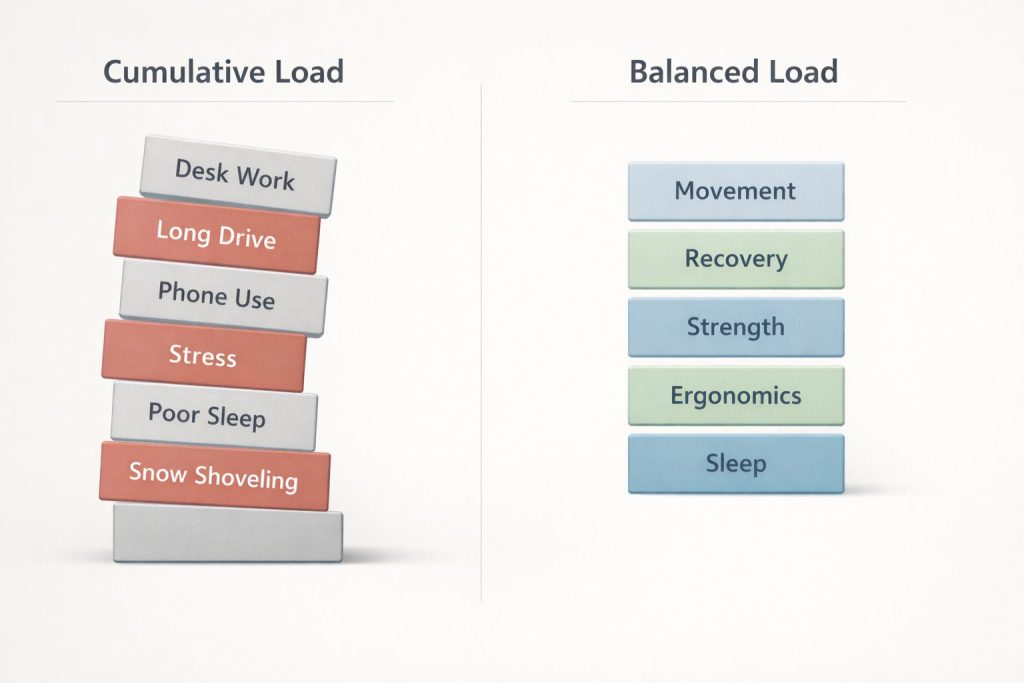
Your spine is being used every day and it is active — not just a passive standby thing that holds things in place. It is under constant load and unloading, keeping us upright and allowing us to sit, drive, walk, run, and do our activities. When these loads are balanced, you usually feel fine. When they stack up without enough recovery, that puts strain on the posture system. That means the postural muscles — and other support tissues — start to get grumpy and let you know.
So let’s do this this February. Instead of focusing only on outward expressions of care, let me encourage a self-reflection that’s both ordinary and powerful: let’s take a more serious look at our spinal health before we’re forced to because of debilitating back pain that “just came out of the blue,” or because an injury finally made things obvious.
In this article, I’m going to cover:
- Why spinal health matters for overall wellness.
- Whether poor posture can truly cause pain.
- Why posture-related pain sometimes comes and goes.
- Why discomfort between the shoulder blades is so common.
- Five practical daily habits to support spinal health.
- When chiropractic care may be helpful.
- And finally, how posture can influence breathing and long-term health.
Nothing we discuss here is meant to solve everything, be a miracle, or promise miracles. It’s about understanding patterns, making a few small adjustments, and knowing when it’s reasonable to get help.
Why Your Spine Matters More Than You Think
Your spine is not just “your back.” It’s a system: vertebrae, discs, joints, ligaments, muscles, and nerves — all working together with the pelvis, rib cage, and the rest of the body. It exists to do three big jobs: support, motion, and protection.
Support is obvious. Your spine holds you upright and distributes load so you can function — carrying a child, sitting in the car, standing bent over a counter, sitting at a desk getting notes done, lifting groceries, or in February, shoveling snow.
Motion matters just as much. The spine is designed to move so you can transition from laying down to sitting up, sitting to standing, and through everyday twisting, reaching, and exercise. It needs enough mobility to move, and enough stability to avoid irritation.
Protection is the last one, and it’s a big deal. The spine protects the spinal cord — the instruction pathway of the brain to the rest of the body.
Now, this doesn’t mean that every symptom is a “nerve problem.” We hear “pinched nerves” a lot, and sometimes nerves are involved. But in many common back and neck cases, the issue is mechanical: how joints move, how muscles and ligaments support those joints, and how tissues respond to repeated strain.
Mechanical pain often responds to changes in function: better movement strategies, better strength and endurance, better recovery habits, and hands-on conservative care approaches when appropriate.
That’s why I often encourage people to move away from “what’s broken?” and toward “what is being overloaded?”
Overload doesn’t mean fragile. It usually just means you’ve been consistent in a pattern that your tissues are no longer tolerating.
Can Poor Posture Really Cause Pain?
That’s a fair question, and the honest answer is: yes, posture can contribute to pain.
But posture is rarely the only thing to blame. It’s not as simple as “good posture good, bad posture bad.” Bodies are different. Histories are different. Work demands are different. A more useful question is: what’s the total load, and how long are you holding it?
If you hold the same posture for a long period of time — especially one that increases strain and puts you out of balanced support — tissues fatigue. Fatigue increases strain because the body can’t hold the posture as well. Over time, that sustained strain can create sensitivities in muscles, joints, and ligaments.
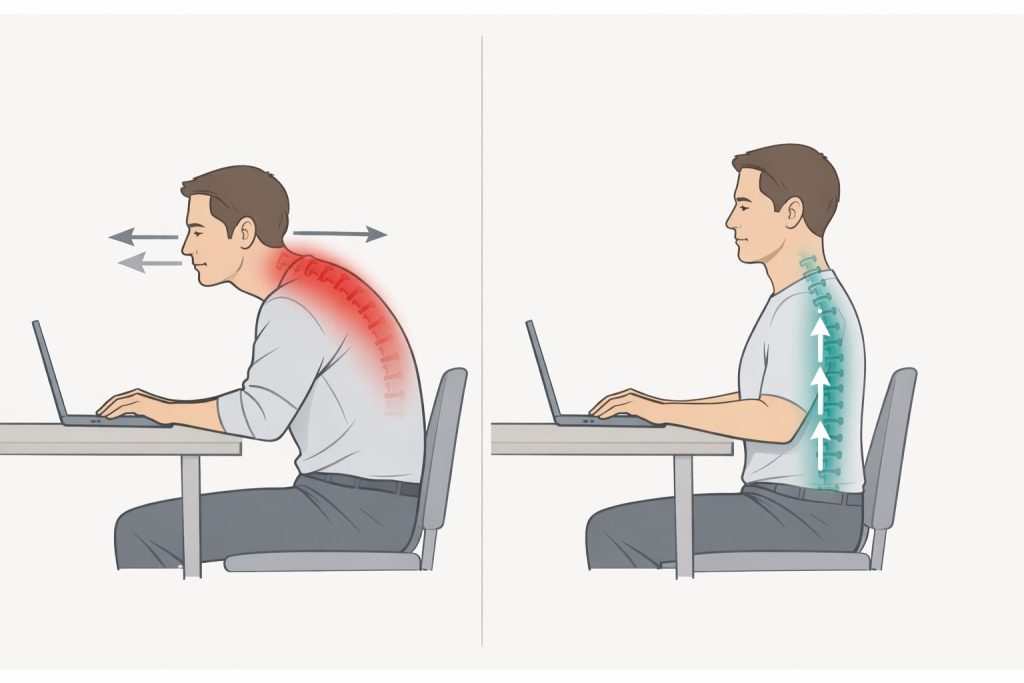
A common example is forward head posture. Believe it or not, your head is not light. When it drifts too far forward, the neck and upper back have to work harder to keep it from falling further forward. Those tissues often anchor into the mid-back, which can create strain between the shoulder blades. The result can be neck tightness, headaches, and upper back pain — not because something is “out of place,” but because certain tissues are doing extra work for too long.
Another example is prolonged sitting. If you sit forward in a chair without the backrest supporting you, the low back postural muscles have to hold the torso up in midair while typing, driving, or watching TV. Some bodies tolerate that better than others, but given enough time, tissues tighten and start complaining.
So yes, posture can cause pain — in the same way holding a heavy grocery bag in one hand can cause forearm fatigue. It’s sustained demand, not moral failure.
Can Posture Pain Come and Go?
Yes — and that pattern is useful.
If your pain comes and goes, that does not automatically mean something serious is happening. Mechanical pain often goes up and down. It changes with time spent sitting or standing, workload and stress, sleep quality, movement or exercise, travel, long drives, and similar activities.
A lot of patients tell me, “My back feels better on the weekend, but during the week it’s horrible.” Often that’s because weekends involve more movement variety and less sustained posture demand. Even if you aren’t “working out,” you might be changing positions more, walking more, doing chores, or simply not being locked into one posture for eight hours.
Stress adds another layer. When stress is higher, shoulders elevate, the neck leans forward, breathing becomes shorter and higher in the chest, and muscles tighten — often without realizing it. That doesn’t mean it’s “all in your head.” It means the nervous system and the muscle/joint system are closely connected, and increased mental stress often shows up as increased mechanical stress.
The practical takeaway: intermittent pain gives you leverage. If it changes, it can often be changed on purpose with smarter habits and targeted care.
Why Pain Between the Shoulder Blades Is So Common
One of the most common spots people feel “posture pain” is between the shoulder blades, and desk work is a huge contributor.
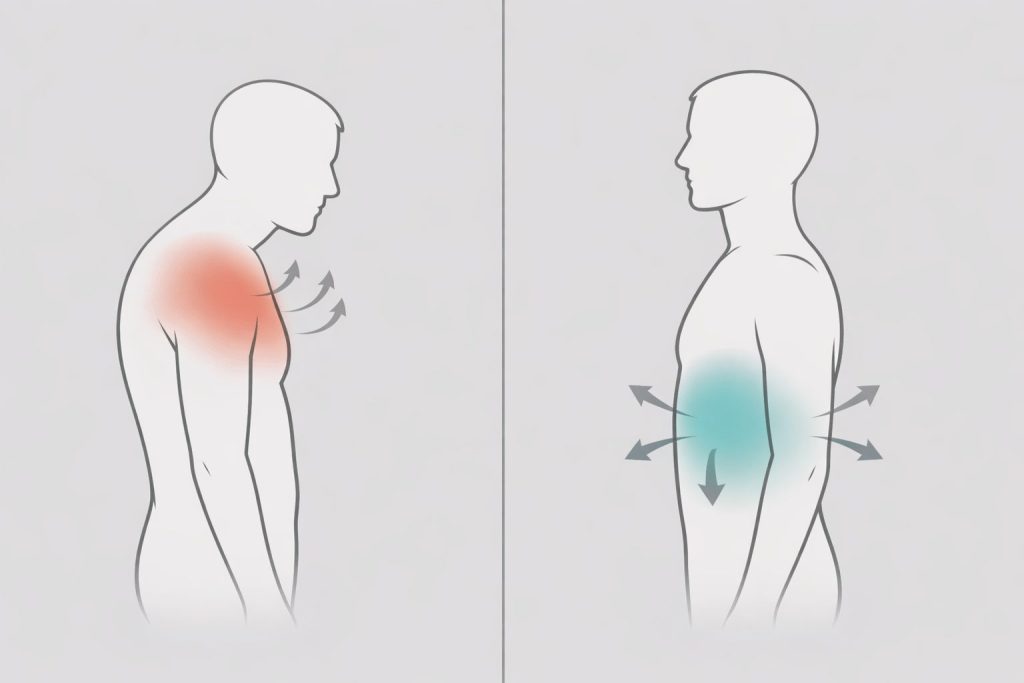
Arms forward brings shoulders forward. Then the body creeps forward because we want to get closer to the screen and focus. The mid-back muscles end up holding tension for hours, and fatigue sets in.
Two common mistakes I see:
- People only stretch. Stretching can help temporarily, but if the position is the driver, stretching is temporary relief for a position problem.
- People force the shoulder blades back hard to “fix posture.” Overcorrecting can create a different kind of strain.
A better approach is balance: improve thoracic mobility so the mid-back can extend, strengthen the mid-back so it can hold posture without fatiguing, and make ergonomic tweaks so tissues can get some rest.
And it’s not just desk work. Other load-stackers show up constantly: long drives, laptop use, phone scrolling, winter inactivity, poor sleep positions (especially stomach sleeping with the neck cranked), and sudden bursts of activity your body isn’t prepared for — like shoveling for hours after a big snowfall.
We can’t avoid life. We just need to be more balanced and strategic in how we use the posture system.
Five Ways to Show Your Spine Some Love This February
Think of these as realistic habits — not perfection. You don’t need perfect posture or a perfect gym routine.
- Micro-movements – Break up long static posture. If you sit at work, set a timer every 30–40 minutes. When it goes off, stand up for 20–30 seconds. Walk around. Roll the shoulders. Do a few gentle chin retractions. Take five to ten slow breaths. If you want a simple rule: the best posture is your next posture. Variety protects you.
- Quick posture resets (not forcing perfection) – Instead of trying to hold “perfect posture” all day, do periodic resets. Bring the rib cage back over the pelvis. Feet flat. Chin in slightly, shoulders down and back slightly. Imagine your head reaching up — without jutting the chin forward. Hold that for 10–15 seconds a couple times an hour. You’re training awareness and endurance.
- Strengthen the mid-back to reduce shoulder blade pain – If your pain is between the shoulder blades, strengthening often changes the game. Simple options: band rows, band pull-aparts, farmer carries, and wall slides. The key is endurance, not max strength. Try two to three sessions a week. Two to three sets. Five to ten reps with control.
- Sleep Support – In general, the most back-friendly start position is on your back — if tolerable. A helpful setup is a pillow under the knees (or calves) so the pelvis can relax into a more neutral position, plus a pillow that supports the neck so the head isn’t tipped forward all night. If back sleeping isn’t doable, side sleeping is next. Keep your head level with a pillow that fills the space between shoulder and head, and support the top arm with a pillow in front of the chest to reduce rotation. Stomach sleeping is generally not recommended because it cranks the neck and loads the upper back.
- Ergonomic changes – If you’re at a desk, aim for a screen near eye level and about one to two feet away. If you use a laptop, prop it up and use an external keyboard and mouse. Sit all the way back in the chair when possible. If your back is irritated, a rolled-up towel (about 3–4 inches in diameter) can support the low back. Keep your feet flat on the ground, and ideally keep hips slightly higher than knees.
When Self-Care isn’t Enough: How Chiropractic Conservative Care Can Help
If you’ve applied these changes and still find yourself enduring neck, upper back, or shoulder blade pain — especially if it keeps flaring — you may need some extra help.
Sometimes you need someone from the outside looking in, because you can’t easily see what you do all day. You live in your posture, so your “normal” becomes invisible.
Here at Integrated Health Solutions, we start with a detailed history, then do an exam focused on posture and movement. We look at tissue tone, joint motion, and how the body stabilizes itself, watching for overcompensations — places where one area is doing work that another area should be sharing.
Chiropractic care, when done responsibly, isn’t about chasing “alignment.” It’s about function improvement, and that equals improved daily life. That can include hands-on care, but also mobility work, stability work, and exercise recommendations that help you keep the changes.
mobility work, stability work, and exercise recommendations that help you keep the changes.
And just as important: if something doesn’t look mechanical — if there are red flag symptoms or neurological concerns — that needs appropriate medical attention. A careful exam helps make that distinction.
Your Posture, Your Breathing, and Long-Term Health
February also brings heart health into the conversation. Posture is not a direct cause of heart disease, and I don’t want to imply that it is.
But posture does influence breathing mechanics. When the upper back rounds and the rib cage collapses, the diaphragm may not expand as freely. Many people begin to breathe more shallow into the chest. Over time, shallow breathing can contribute to tension, fatigue, and reduced exercise tolerance.
So I don’t bring up breathing to scare anyone. I bring it up because it’s practical. When posture improves, breathing often feels easier. When breathing improves, the body tends to feel calmer.
Conclusion
Your spine doesn’t need perfection. It needs attention, variation, and support.
If you’ve noticed your pain comes and goes, that it flares after desk work or driving, or that it sits between your shoulder blades by late afternoon, those patterns often point to mechanical overload — not hopeless damage.
Start small:
- Move more often.
- Reset posture periodically.
- Strengthen the mid-back and core.
- Improve sleep alignment.
- Make your workstation less demanding.
And if you’re not sure what’s driving your symptoms, a thoughtful evaluation can help you stop guessing and start addressing the real contributors.
This month, show your spine some love — not with panic, not with pressure — but with practical stewardship.
If you’re in Carmel, Fishers, or Indianapolis and want a plan that fits your life, I’m glad to help you explore options and build a sensible path forward.
Your spine supports you every day. Caring for it is one of the simplest ways to invest in your future.
Content Provided By Dr. Andrew Sanders