Most, if not, all of us have been told at some point in time during our lifespan that we needed to work on or improve our core strength. But what is it that that really means? The core is effectively broken down into a series of muscles in your lower abdominal and pelvic region, consisting of the abdomen itself, but also entails the upper portion of your hips and gluteal muscles as well as the muscles wrapping around your waist and pulling into your lower back. Your body uses these muscles as its central stabilizing force. When these muscles are weak or not used properly, through compensation, the body is not able to use the central stabilizing entity as effectively as it possibly can. This leads to a series of compensations and dysfunctional use utilizing the other surrounding muscles. This can lead to a plethora of injuries, ranging from a very simple and straightforward, lower back pain and tightness, and ranging all the way to a dysfunctional motor control or even improper fundamental movement in babies and children.
The use of your core musculature is extremely important for each and every one of us throughout the stages of our lifetime. This is used in most if not all of our daily motions from getting out of bed and sitting up straight to lifting, picking up and carrying even the lightest of objects. There are many compensatory triggers that we can do throughout our lives that effectively shut off or decrease the usage of our core. Starting in infancy, the core is used in a proper motor and neurological development and how it is that we begin using our bodies. Most people know the series of movements and activities that a child is supposed to go through during infancy, but most of us don’t truly understand why it is that that is important. The truth behind the neurological development of how it is that we move our bodies from birth lies within our core strength. Things like tummy time to crawling and eventually even walking, all lead into the development in proper functional usage of our core. If this simple stage is either incorrectly addressed or skipped, it can lead to a series of dysfunctional movements and compensation throughout the remainder of our lifetime. In today’s day and age, where most people lead a very sedentary lifestyle, the core is not a very important part of our daily working routine. Whether it be chest breathing, poor posture, lifting and loading with your back or legs or one of the other thousands of things we do during the day, we are setting ourselves up for failure when improperly, or altogether, not using our core.
In this blog, we are going to go in depth and the description of why it is that the core muscles are a pertinent part of all of our stabilizing forces, and how it is that the doctors at Integrated Health Solutions can assist you in the development and proper usage of said muscles. We will be going over the proper treatment protocol that we use at IHS that allow us to properly and functionally develop these muscles and give you the tools to combat the sedentary lifestyle that many of us lead. We will also go over the assessment protocol done at IHS that allows us to understand where your deficits and dysfunction are underlying. Let’s get started!
The first thing that you will do with the doctors in our facilities on your first visit is a functional movement assessment and analysis so that the doctor may properly understand the functionality and compensatory deficits that you may be facing. The doctors do this by using a protocol known as SFMA (Selective Functional Movement Assessment). This allows the doctors to put each and every patient through a series of movements to determine what dysfunctional capacity the person may be struggling with. This effectively enables the doctor to come up with a direct and individual individually targeted treatment plan to assess tissue density, joint stability, dysfunctional and compensational movement and even core strength. The doctor can then take that knowledge and develop a proper protocol to give you the best quality of pain-free living. That treatment typically consists of a four prong approach with the usage of our main treatment methods: dry needling, soft tissue manual therapy, chiropractic Adjustments and dynamic/functional rehab rehabilitation. Now let’s break down each of these to truly understand how it is that these impact your core’s ability to function properly, and why it is important to have these treated.
Dry needling is one of if not the most important treatment methods used by our doctors here at IHS. Dry needling, put simply, is the use of an extremely thin filament to puncture the skin and penetrate deeper into the designated muscle area to stimulate activation, decreased pain, response, and most importantly, instigate the innate biological healing response. This approach can commonly be compared to that of a traditional acupuncture. There are two main differences between the two approaches: the targeted tissue being worked on and the appropriate depth of penetration. A traditional acupuncture approach targets and energy channel within the body known as Chi and maintains a shallow insertion point. The more modern dry needling approach targets a musculoskeletal entity, and therefore requires a deeper insertion. The doctors at IHS apply a protocol known as homeostatic acupuncture, which is a complex overlay of the two treatments which allows one to receive acupuncture benefits while simultaneously receiving a dry needling based treatment. This is the first of the four treatments that all patients receive at IHS to reset the sympathetic nervous system, release muscle tension, and spasm, and reduce the pain response. This puts the body in a much more receptive state to be able to accept the functional rehab rehabilitation given at the end of each visit.
The second treatment approach is soft tissue manual therapy. This can be done in a varying amount of ways ranging from IASTM (Instrument Assisted Soft Tissue Mobilization), to ART (Active Release Therapy/Treatment) or even hands-on manual therapy work. This tissue work is always performed after dry needling to achieve the most optimal benefit. By using their own hands, a tool, or even the own muscle activation of the patient, the doctor is able to increase the amount of circulatory response to a corresponding muscle area and create a more neutrally aligned muscle fiber response. This is Paramount after the dry needling for not only a quicker and heightened healing response, but also for the most comfortable reactivity. While effective, dry needling is rather aggressive to the soft tissue, but when followed by the more gentle soft tissue approach the muscle fibers are able to not only repair themselves, but do so in a functional and ergonomic fashion. Some people think of massage or manual therapy work and attribute a rather aggressive approach, whether it be seen on social media or through an experience of their own. This is not how the doctors at IHS apply this protocol. Because of the prior usage of the dry needling treatment, our soft tissue is significantly less aggressive than that which most people are experienced with. This allows for an overall much more comfortable treatment for the patient, while still maintaining and extremely high efficacy.
The third treatment approach is the chiropractic adjustment. This is the most commonly associated treatment with chiropractors, and for an obvious reason. This involves a most commonly direct and manual pressure with the doctors hands to a joint segment to induce motion. Most of us have come across this on social media, pages or have even experienced that hands on ourselves. When muscle tissue becomes compensated and dysfunctional, it applies an asymmetrical pressure on the attachment site to the corresponding joint. All muscles in the body have a beginning and ending point attached to a separated joint. When the muscles become dysfunctional this then subsequently creates dysfunctional pressure or mobility within the joints. Therefore, after releasing the tension and creating an economic and functional muscle tissue, it only makes sense that the subsequent joints are then corrected as well. This approach induces motion into the joint by removing air that is thrust into the synovial joint space. When fluid is then placed back into the joint space, the proper range of motion is then restored. This allows for a greater range of motion and in a more functional and pain-free sense.
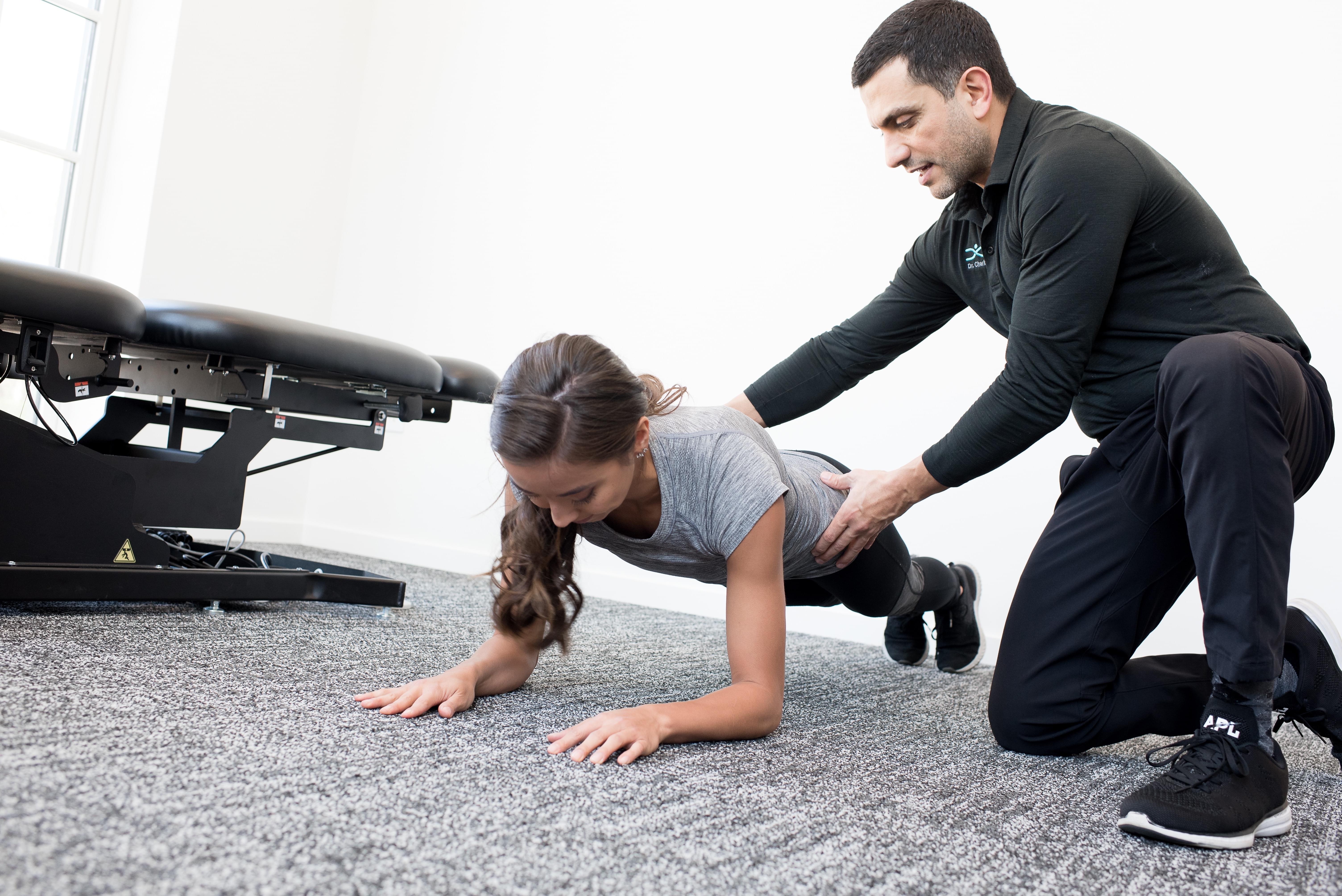
Lastly, the final and arguably most important treatment method applied by our doctors here at IHS is what we refer to as dynamic/functional rehabilitation. This is going to be the driving factor in our course ability. The doctors here at IHS use an overlapping approach, combining SFMA and DNS to reset the neurological system in the body and create a foundational strength centered around our core. While our rehabilitation protocol includes things such as daily stretching, and light massage to ergonomic and functional posture, both sitting and sleeping, the most important approach included in our rehab protocol is the foundational core strength. We use a simple yet effective approach to core strength that enables the body to not only truly harness, the strength and power of the central core, but to do so, in a much less aggressive fashion than most of us are used to. When you think of core work, what is the first thing that comes to mind? Most of us would answer “laying on the gym floor and doing 1000 crunches”. And while that may be the stereotypical and more common response, there is a much simpler approach to core strength. By using the DNS protocol, we enable patients to discover their own central stabilizing unit and decrease the heavy reliance on the surrounding muscles. This will consist of a series of fundamental core exercises, such as the dead bug, the bird dog, and even the side plank. These exercises address core strength, while maintaining a spinal neutrality that does not cause a subsequent detriment to our patients. This creates a confidence that patients now have the ability on their own to work on the most paramount part of their body and everyday lifestyle, without exerting too much effort or risking potential injury.
Now, putting all of that together, do we think that core strength is important? ABSOLUTELY. The core is the beginning, middle and end to our central and fundamental stabilizing ability. Without an effective and usable core, the quality of life that one may ascertain is significantly lower than that of somebody who has the ability to effectively use their core. Now just because we focus on increasing core strength, does not mean that we need you to have a visible six pack.While it may be appealing to the eye, there are plenty of patients in our office with abdominal tone that do not know how to function functionally and properly use those muscle muscles. Do not be discouraged if you are feeling like you’re starting behind, or if you have never targeted these muscles before. Our approach gently blends all facets of lifestyles to create an easy to follow and extremely effective protocol to create your best core strength.
If you are interested in seeing the dramatic impact that a proper and functional core can have on your body, please do not hesitate! You may reach out to our doctors and our office here on our website, via email or by simply picking up the phone and giving us a call. Our incredible staff can’t wait to get you into the office and in front of our well trained and excellent doctors and see the best version of you that can be made possible. Don’t wait any longer. Come on in and let us help you become the best you that you can be! See you soon!
Content provided by Dr. Jordan Miller