Breathing is heavily influenced by posture: how you hold your torso changes how your diaphragm can move.. Here’s what poor posture can silently be doing to your breathing, your stress, and your wellbeing.
How Posture Affects Your Diaphragm and Lung Function
The diaphragm is a dome-shaped muscle sitting just below your lungs. It connects to the bottom of your breastbone, lower ribs, and several lumbar vertebrae. When you inhale, it contracts and flattens downward, creating a pressure difference that draws air into the lungs and causes them to expand. However, this negative pressure can be affected by the shape of your torso.
When you slouch (like at a computer), several things change from ‘ideal’ posture. Your shoulders become rounded, your chest caves in, your head leans in front of your body, and your ribcage compresses. Slouched posture reduces the space the diaphragm needs to descend, limiting efficient inhalation.. When diaphragmatic (belly) breathing is impaired, we instead rely on accessory muscles and breathe into the upper chest. Unfortunately, we tend to breathe up into our neck when we cannot breathe out. The muscles that help us do that are called accessory breathing muscles and are in the neck and shoulders to lift the ribcage. The result is shallow, labored breathing that causes neck, upper back, and jaw tension and that uses a fraction of your lung capacity.
This measurable effect helps explain why everyday slouching — at desks or while driving — can progressively reduce breathing efficiency..
Source: PubMed — Diaphragm Posture Studies
This type of posture is extremely common due to the amount of time we spend slouched over in this modern world. Desk jobs, students, laundry, dishes, driving, and cleaning….they all have components of leaning and reaching forward. These are some of the most common movements we make and some of the most frequent positions we are in during the day.
Poor Posture and Anxiety
Amazingly, when we breathe upward and use our neck to help us breathe, our stress and anxiety can be activated. This happens due to upper chest breathing activating our sympathetic nervous system and setting up our ‘fight or flight’ response. Feelings of tension, edginess, and stress appear when nothing is really wrong or happening. It is normal to breathe this way in a stressful situation or with maximal exertion when exercising, but breathing this way when that is not the case, can cause you to feel as if you are in a situation with mental or physical stress.
These feelings sometimes lead to a hunched over or protective posture, which will further cause even more poor breathing. You get the idea. This is a small problem that can quickly become very chronic. This poor posture changes your breathing, causes anxiousness, and is a self-reinforcing loop that is difficult to stop. There are several signs to look for to know if this is happening to you:
- Chronic tension in the neck, jaw, or upper back
- Feeling “wired but tired”; feeling exhausted but unable to relax
- Holding your breath, or large periodic sighs
- Anxiety that spikes in situations that doesn’t make sense…such as sitting at your desk
- Shallow breathing that never quite feels satisfying, or a feeling of not being able to get enough air
Benefits of Breathing-Focused Care
The upside of this posture–breath connection is that it works in reverse! When you restore mobility and release tension — through targeted manual therapy, rehabilitative exercises, and awareness — the cascade of benefits is rapid and measurable. We achieve this by adding diaphragmatic-breathing drills (for example, 90/90 breathing) into progressive functional exercises. The exercises are then progressed in difficulty, step by step, in order to finally arrive at fully functional compound exercises with a stable core, good posture, and proper breathing patterns.
The changes these exercises can bring are varied and sometimes unexpected. These changes can manifest as better sleep, reduced anxiety, reduction of headaches, and improved athletic performance. Decreased neck and upper back tension improves the first three. Athletic performance improves because efficient breathing delivers more oxygen to working muscles with less effort.
Harvard Health has documented how upright posture not only improves breathing mechanics but actively shifts hormonal balance — reducing cortisol and increasing feelings of confidence and calm. The body and mind are not separate systems.
Even more amazingly, integrating proper diaphragmatic breathing with the ability to brace your core is fundamental for good higher level movements and preventing injury. So making sure you are performing this correctly, is crucial and pays dividends for years!
How We Assess You in Our Clinic
A comprehensive assessment provides a clear, objective picture of where movement is breaking down and what is driving it. Our assessment begins with asking how stressed you feel and what position you use daily for work and at home. This gives us a good picture of patterns that we may be able to change in order for you to have a faster and longer lasting result.
Below are some of the most important checks we go through during a first visit.
- Posture Screen
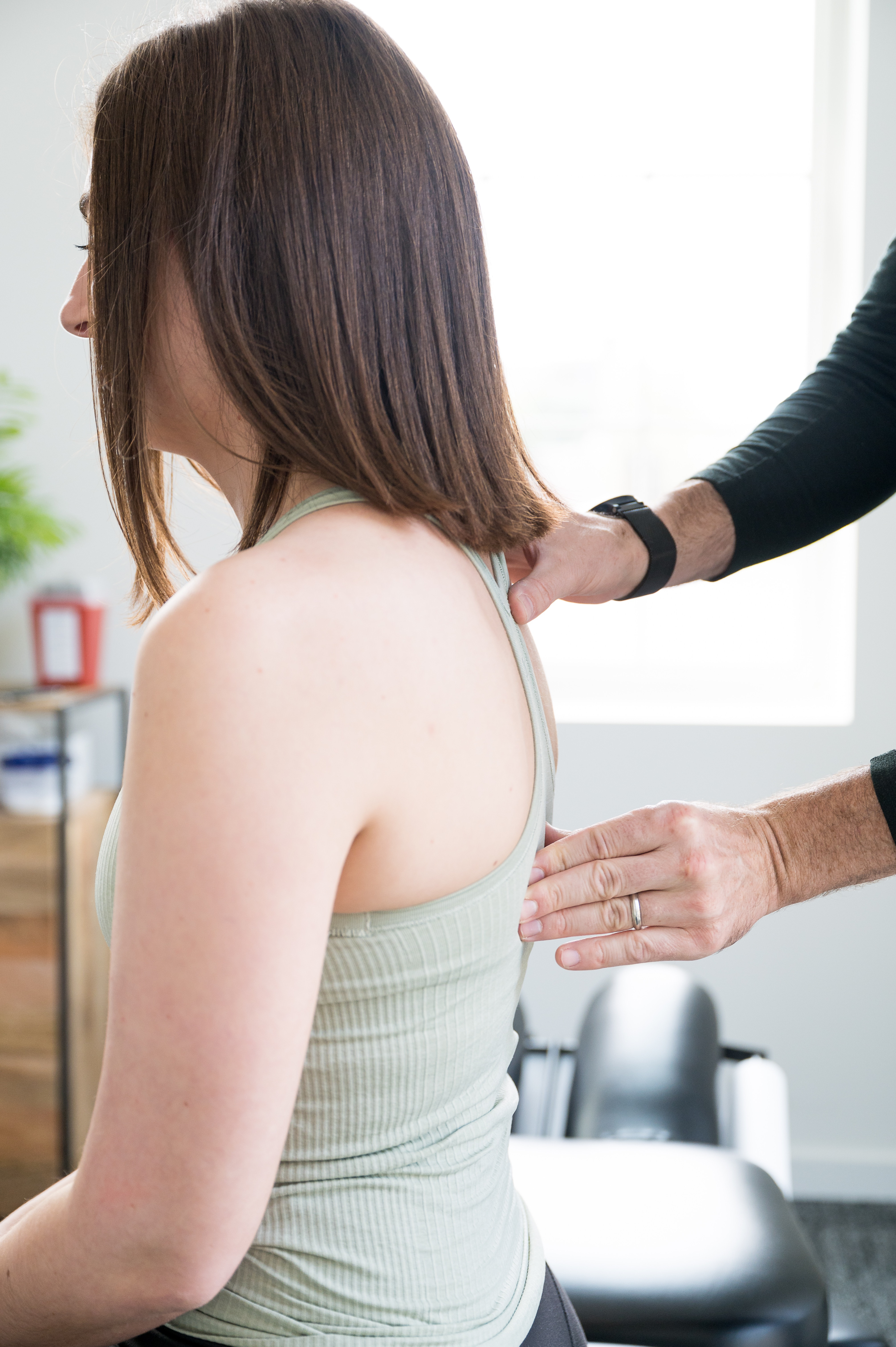
- We evaluate you sitting and standing to see if your shoulders are at an even elevation, if your head is in front of your body, how rounded your shoulders are and if you are able to bring your scapula back and down your back, where they belong.
- Laying down and Seated Breathing Testing
- We also check your ability to breathe into your belly when laying down and if you are able to brace your abdomen while diaphragmatically breathing. This same movement is also measured by hand in a seated position, as it is more difficult in this position. The doctor’s hands should move away from the center with each breath. Some people are able to perform it correctly laying down, but many have more trouble when upright initially.
- Mobility and Range-of-Motion Screen
- For the more hands on portion, we assess thoracic rotation, hip flexor tension, and shoulder mobility — the three areas most commonly restricting upright posture. Sometimes only one is present, but severe cases may have all 3 issues at the same time.
- We look for segmental mobility in the thoracic spine and rib cage, as well as palpating for muscular and fascial adhesions. These can place strain on the ability to fully expand the lungs. This includes scar tissue from trauma or prior surgeries, as well as possible congenital differences of the rib cage. I have seen childhood surgical scars that caused an amazing amount of torque in the abdomen and affected the ability of the ribs on one side of the body to expand evenly with the other side.
- We also evaluate you standing and moving your neck and arms in order to find limited movements in either area. Additionally, rib flares and a type of hernia in the rectus abdominus muscles, called a diastasis recti, are also evaluated. These can also make it difficult to breathe properly and can be associated with other, less ideal, breathing patterns.
- Functional Breathing Pattern Observation
- Although it is important to be able to breathe correctly when laying on your back or if seated, it is also important to be able to maintain that during exercise and compound movements. We observe your breathing at rest and during movement to identify accessory-muscle overuse, breath-holding, and paradoxical breathing patterns. Holding your breath while performing a difficult task or when stressed is a common pattern that can significantly contribute to a poor pattern of breathing and activation. Maybe you are able to maintain diaphragmatic breathing for easier exercise, but switch to accessory breathing when using multiple limbs or when standing or lunging. The ability to maintain across all movement patterns is necessary for best outcomes and is how we are built to move and breathe.
- Personalized Treatment Plan
- Our goal is to have fully explained why we’re performing treatment, as well as specific and measurable goals for the treatment, full transparency in the pricing of the treatment, as well as a good idea of what will be involved in the treatment and about how long it will take to meet the goals. You leave with a written, prioritized and specific-to-you plan, that is tailored to your individual findings.
At-Home Breathing and Posture Drills
These four short drills take under ten minutes and can be performed anywhere; practice daily for best results.. No equipment is required and they can significantly improve your ability to breathe properly.
- 90/90 Diaphragmatic Breathing
- Lie on your back with knees bent at 90°. Place one hand on your chest, one on your belly. Inhale for 4 counts — only the belly hand should rise. Exhale for 6 counts. Repeat 10 times. This retrains the diaphragm to lead the breath rather than the accessory neck muscles. If this is too difficult, you can try placing a weight of 2-5 lbs on your lower belly. Imagine breathing down to the weight and see if that helps.
- An alternative peel back is to lay flat on your stomach with your head to the side and breathe into your belly so that you feel your back stretching with each breath.
- Doorway Chest Opener
- Stand in a doorframe or corner with arms at 90°. Gently lean forward until you feel a mild stretch across the chest and front of the shoulders. Hold for 30 seconds, repeat 3 times. This directly reverses the forward-rounding posture pattern that compresses the lungs by stretching the pectoral muscles. Once the pectorals are more relaxed, the shoulder blades can drop down the back and the chest opens up even more. This is one of the single most important stretches for setting yourself up for success! Like dominoes falling, if the shoulders are rounded, many other postures and movements are affected.
- Chin Tuck with Deep Breath aka ‘The Double Chin’
- Sitting upright, gently draw your chin straight back (not down). This usually creates a double chin. It is especially easy to perform in the car as you can press your head straight back, into a head rest. But, please do not do this while driving! Now, take a full, slow inhale. Notice how much easier it is to breathe with the head correctly stacked over the spine. Perform 10 repetitions. This briefly corrects forward head posture, which opens up your chest and gives the diaphragm more room.
- Box Breathing Reset
- Inhale for 4 counts · Hold 4 · Exhale 4 · Hold 4. Repeat for 5 minutes. This powerfully activates the parasympathetic (rest and digest) response using vagus nerve stimulation and thus interrupts the shallow-breathing anxiety loop. Best performed sitting tall in a chair, but can also be done laying on your back on the floor with your knees up and feet flat on the floor.
Restore your Breath
If, despite practice, you cannot do belly breathing while keeping your chest hand still, consult a practitioner like those at Integrated Health Solutions to integrate breathing into exercises. Very often people can progress themselves at home with some of the exercises found above. But every once in a while, someone has a lot of trouble jump starting this proper movement and finding the right pattern. They can still get there, it just takes a little bit more effort and expertise care.
Sources:
- Harvard Health — “3 Surprising Risks of Poor Posture”
https://www.health.harvard.edu/healthy-aging-and-longevity/3-surprising-risks-of-poor-posture
- Harvard Health — “Learning Diaphragmatic Breathing”
https://www.health.harvard.edu/healthbeat/learning-diaphragmatic-breathing
- PubMed / PMC — “Severity of Kyphosis and Decline in Lung Function: The Framingham Study”
https://pubmed.ncbi.nlm.nih.gov/27341855
- PubMed — “Effect of Adding Diaphragmatic Breathing to Corrective Exercises on Kyphotic Angle”
https://pubmed.ncbi.nlm.nih.gov/38821882
- Frontiers in Psychology — “The Effect of Diaphragmatic Breathing on Attention, Negative Affect and Stress in Healthy Adults”
https://www.frontiersin.org/journals/psychology/articles/10.3389/fpsyg.2017.00874/full
- Frontiers in Bioengineering & Biotechnology — “Breathing, Postural Stability, and Psychological Health”