
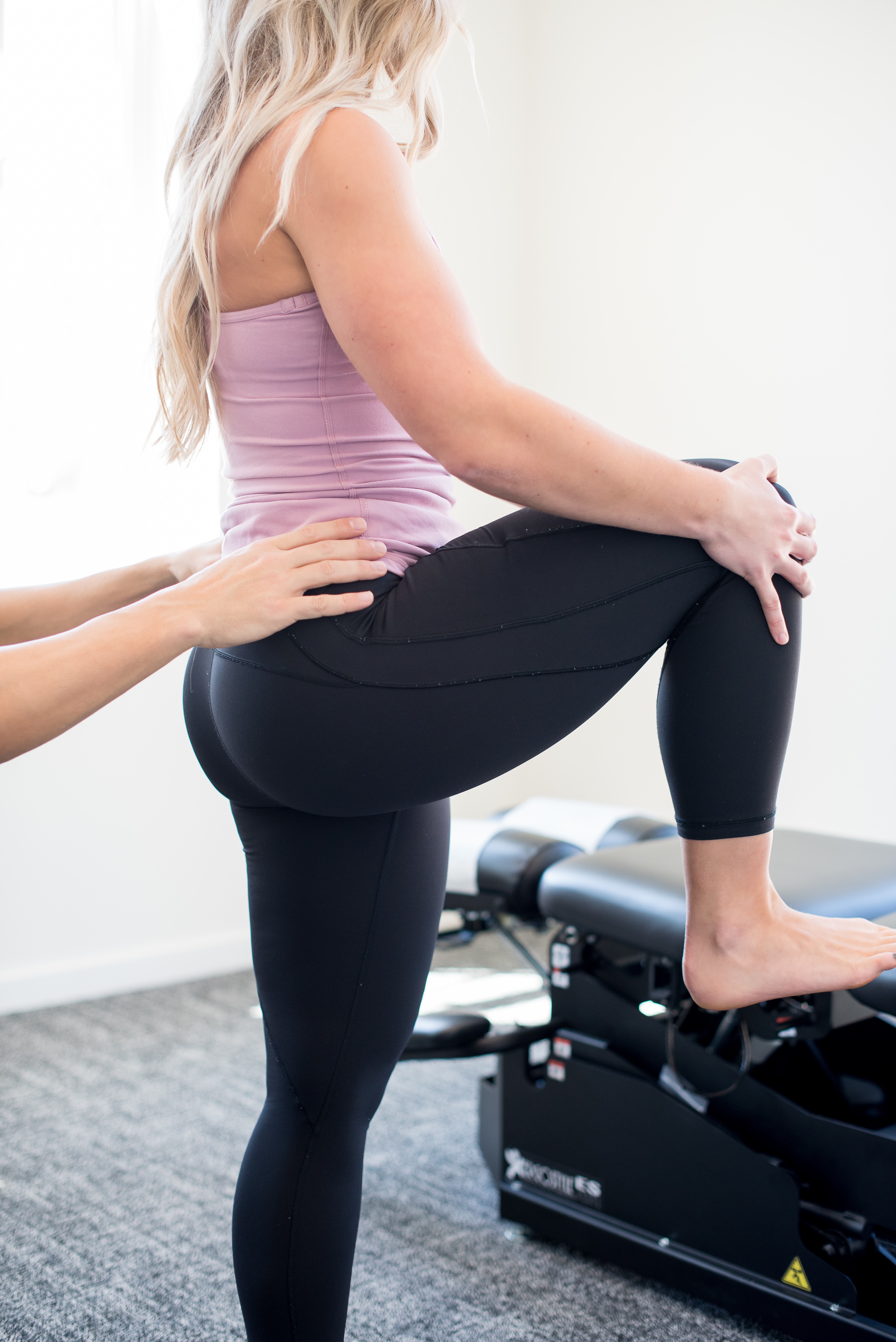
If you’ve been googling “foot pain causes” at 11pm with an ice pack strapped to your heel, I already know what you’ve found. Plantar fasciitis. Heel spurs. Flat feet. Bad shoes. Maybe a YouTube video of someone rolling their arch on a frozen water bottle.
Those may all be accurate, and while I prefer a frozen golf ball, the water bottle can help.
But here’s the thing I find in my treatment room almost every week: the place where you feel pain and the place where the problem lives are often two entirely different areas. With stubborn foot pain, the trouble frequently started two joints up, at the hip.
This is the stuff I wish every person with heel pain knew before their third pair of orthotics.
The Chain Between Your Hips and Feet
Your leg is a chain of linked segments: pelvis, femur, knee, shin, ankle, foot. Clinicians call it the kinetic chain, and the short version is that no joint down there works alone. Every step sends force up the chain, and every position your hip takes sends instructions down it.
The hip’s job in this chain is bigger than most. The muscles on the side of your hip, especially the gluteus medius, hold your pelvis level and keep your femur from rolling inward when you’re standing on one leg. Which, by the way, is what walking is. A series of controlled one-leg stands, thousands of times a day.
When those hip muscles are weak, or the hip joint itself is stiff, the femur drifts into internal rotation. The knee follows. The shin follows the knee. And the foot, sitting at the bottom of all of it, gets pushed into more pronation than it was built to handle. The arch flattens harder and stays flattened longer with each step, and the plantar fascia, that thick band of tissue under your foot, gets stretched like a bowstring that never gets to relax.
There is a published case report where hip strengthening was central to resolving plantar fasciitis, plus biomechanical work showing that hip abductor fatigue measurably changes knee mechanics during ordinary walking. The chain runs both directions, too: a study of people with prior inversion ankle sprains found hip abductor weakness on the same side. Foot problems create hip problems just as readily as the reverse, and the body has never respected the habit of treating joints one at a time.
What Watching You Move Actually Shows
Every time your foot hits the ground running, the force coming back through your leg is something like two to three times your body weight. Walking is gentler, but you take eight to ten thousand steps a day. Small mechanical errors, multiplied by numbers like that, become tissue damage. It’s called repetitive microtrauma and it is the cause of most overuse pain.
Movement assessment is how we catch the errors. We watch you walk, and often run — sometimes on video, always with a trained eye — looking for things you can’t feel from the inside:
- Does your pelvis drop on the opposite side when you’re mid-stride? Clinicians call this contralateral pelvic drop, and it’s the classic signature of a gluteus medius that isn’t holding.
- Does your knee dive inward when your foot loads?
- Does your foot pronate too early, too much, or for too long? Pronation itself is normal. The timing and amount are what matter.
- Do your feet cross over an imaginary center line when you run?
- How’s your cadence? Overstriders load their heels like hammers.
The research supports what shows up on video. Increased foot pronation changes the mechanics of the whole limb during gait and can overload the knee and hip, and one study found that pronated feet altered lower extremity loading after a 5k run, with hip joint forces rising at foot contact. Fatigue makes all of it worse, which is why your foot pain shows up at mile three and never at the start.
Here’s my favorite part of this work, honestly. The ‘aha’ moment when someone feels their body make the error after they understand what it is.. You can tell someone their hip drops. Showing them is different
Foot Pain that Gets Misdiagnosed, or Half-diagnosed
I want to be careful with the word “misdiagnosed,” because the diagnosis on the paper is often technically right. You do have plantar fasciitis. The tissue is genuinely irritated. What’s missing is the second half of the sentence: why.
The WHY is the most important and least asked question. It is what determines true long term success, from short term improvement.
Some patterns I see over and over:
Plantar fasciitis that keeps coming back. The fascia gets treated with stretching, ice, maybe an injection. It calms down. Six weeks later it’s back, because the hip dysfunction that was overloading it never got addressed. Treating the fascia alone is like mopping the floor without fixing the leaky pipe.
“Heel spurs” taking the blame. Plenty of people have heel spurs on X-ray and no pain at all. The spur is often a bystander. Fix the mechanical overload and the spur can stay right where it is, bothering no one.
Pain along the inside of the ankle or arch usually gets filed under flat feet. What I often actually find is a posterior tibialis working overtime, decelerating pronation the hip should have controlled from above.
Forefoot pain in runners gets blamed on shoes. Then the slow-motion video shows a crossover gait pattern loading the outside edge of the foot, with weak lateral hip stabilizers behind it.
I’m not saying the foot never has its own problems. Sometimes a foot problem is a foot problem. Stress fractures, nerve entrapments, arthritis, true structural issues. Part of my job is ruling those in or out, and when something needs imaging or a referral, it gets one. But when foot pain has survived rest, new shoes, orthotics, and months of arch stretches, the odds that the driver lives somewhere else go way up. And even the above structural issues have a ‘why’.
How Our Clinic Handles This Differently
All of this comes down to looking at the whole person instead of the sore spot, and we’ve built the clinic around exactly that.
Our assessment starts with the SFMA, the Selective Functional Movement Assessment. It’s a clinical system built on a concept called regional interdependence, which is a formal way of saying what this whole article has been saying: the painful part and the dysfunctional part are often different parts. Instead of staring at your heel, the SFMA takes you through whole-body movement patterns and breaks the faulty ones down piece by piece until we find the link that’s failing. Sometimes that’s a stiff ankle. Very often, with foot pain, it’s a hip that has quietly stopped rotating or stabilizing. We also watch you walk, because how you load your feet under real steps tells us things a table exam can’t.
Then treatment runs on two tracks at once. To calm the irritated tissue down, we use adjustments, soft tissue work, and dry needling where it’s appropriate, because you deserve to hurt less while we fix the bigger picture. And to fix that bigger picture, we rebuild your movement with functional rehabilitation based on Dynamic Neuromuscular Stabilization, or DNS. DNS trains your hips, trunk, and breathing to stabilize you the way they did before years of desks and old injuries got in the way, using positions borrowed from how babies develop movement in the first place. It sounds odd until you feel it work — where an isolated exercise strengthens a muscle, DNS gets the whole chain using it again.
The last piece is retesting. The SFMA gives us a baseline, so as treatment progresses, we re-screen. If your movement improves and the pain doesn’t, we rethink. Years ago I spent six weeks treating what I was sure was garden-variety plantar fasciitis, and it turned out to be a nerve entrapment that needed a completely different approach. A re-exam caught what my first exam had missed, and that embarrassment is a big part of why we re-screen on a schedule instead of trusting my certainty. I’d rather change course in week three than discover in month four that we were treating the wrong thing.
Mobility Works For Your Hips and Ankles
If your foot pain has been hanging around, get it assessed. But these five exercises are a safe starting point for most people, and they target the links in the chain that cause the most trouble. Stop anything that produces sharp pain.
Half-kneeling hip flexor stretch. Kneel on one knee, tuck your tailbone under slightly, and shift forward until you feel a stretch down the front of the kneeling-side hip. Squeeze the glute on that side. Hold 30 to 45 seconds, twice per side, daily. Desk workers, this one is for you.
90/90 hip switches. Sit on the floor with both knees bent at roughly right angles, one leg in front, one to the side. Rotate both knees over to the other side, slowly, and back. Ten slow reps. Hip rotation is where a lot of stiffness hides.
Side-lying leg raises or banded lateral walks. This is your gluteus medius, the pelvis-leveler. Lie on your side, keep your body in one line, lift the top leg without rolling backward. Two sets of fifteen per side. When that gets easy, add a band around your knees and walk sideways.
Single-leg glute bridge. Flat on your back, one foot planted, drive through the heel and lift your hips. Two sets of ten per side with a pause at the top. If your hamstring cramps, you’ve just learned something about which muscles have been covering for your glutes.
Knee-to-wall ankle rocks. Face a wall, foot about a hand-width away, and drive your knee toward the wall without lifting your heel. If the ankle can’t get there, the foot compensates elsewhere on every step. Ten slow rocks per side, daily.
Give it four to six weeks before you judge the results, because mobility improves slowly no matter how motivated you are.
Pain Often Starts Somewhere Else, Lets Find the Location
If your foot pain has outlasted the rest, the shoe rotation, and the frozen water bottle, it’s probably time to stop interrogating the foot and start examining the chain it hangs from. Book an assessment with us. We’ll look at all of it, hips included, and build you a plan aimed at the cause.
And if you’re a clinician with a stubborn heel-pain patient who isn’t responding, we’re glad to co-manage — send them over for a movement screen and we’ll share what we find.
Your foot has been telling the truth this whole time. It’s just not the whole truth.
Content Provided By: Dr. Elizabeth Bouse
Sources:
- The effects of hip strengthening exercises in a patient with plantar fasciitis: A case report — https://pmc.ncbi.nlm.nih.gov/articles/PMC6617481/
- Ipsilateral hip abductor weakness after inversion ankle sprain — https://pmc.ncbi.nlm.nih.gov/articles/PMC1421486/
- The effect of hip abductor fatigue on knee kinematics and kinetics during normal gait — https://pmc.ncbi.nlm.nih.gov/articles/PMC9577318/
- Effects of foot pronation on lower limb sagittal plane biomechanics during gait — Gait & Posture — https://www.sciencedirect.com/science/article/abs/pii/S0966636218317351
- Foot pronation contributes to altered lower extremity loading after long distance running — Frontiers in Physiology — https://pmc.ncbi.nlm.nih.gov/articles/PMC6540596/