If you’ve ever experienced that nagging, sharp, or achy pain on the outside of your knee, especially when walking, running, or climbing stairs, you’re not alone. Lateral knee pain is a common complaint I encounter in my chiropractic practice.
For many people, the first assumption is that the knee itself is the problem. Maybe it’s an injury, inflammation, or something “off” with the joint. While that can certainly be true, in a surprising number of cases, the real issue lies above or below the knee; specifically, in the hips and feet.
You see, your body doesn’t work in isolated parts. It’s a connected system, or what we call a kinetic chain. Every joint affects the movement of the others. If one area doesn’t move well, another area has to compensate, and over time, that can lead to pain or injury.
Today, we’re going to dive deep into why your hips and feet might be contributing to your lateral knee pain, what’s really happening biomechanically, and how improving mobility and strength in these key areas can relieve stress on your knees for good.
Understanding Lateral Knee Pain
Before we talk about causes and solutions, let’s clarify what we mean by lateral knee pain. The “lateral” side of your knee refers to the outer side, the area that faces away from your other leg.
This pain often develops gradually rather than from one specific event. It can show up during running, cycling, squatting, or even after sitting for long periods. Common causes include:
- Iliotibial Band (IT Band) Syndrome: The IT band runs from your hip down the outside of your thigh to your knee. Tightness or friction in this area can lead to irritation on the outer knee.
- Lateral Collateral Ligament (LCL) Strain: This ligament helps stabilize your knee. Repetitive stress or trauma can strain it.
- Meniscus irritation: The outer portion of your meniscus can become irritated or worn, especially if your knee is rotating excessively during movement.
However, the key thing to understand is that these are symptoms, not necessarily root causes. The real problem often starts elsewhere, particularly with the way your hips and feet move (or don’t move).
How the Hips Influence Knee Pain
Your hips are one of the most powerful and mobile joints in your body. They control the rotation and positioning of your entire leg. When your hips aren’t functioning properly, your knees are often the ones that pay the price.
Weak Glutes = Unstable Knees
The gluteal muscles, primarily the gluteus medius and gluteus maximus, play a crucial role in stabilizing the pelvis and controlling the alignment of the femur (your thigh bone).
If these muscles are weak or underactive, it can cause your femur to rotate inward during walking or running. This inward collapse, known as valgus collapse, forces the knee to cave toward the midline. The result? Extra strain on the structures along the outer knee, including the IT band and LCL.
Tight Hips = Restricted Movement
On the other hand, if your hip mobility is limited, for example, tight hip flexors from sitting too long, your hips can’t move freely during motion. This restriction means your knee has to pick up the slack, often twisting or moving in ways it wasn’t designed to. Over time, that leads to pain and inflammation.
Improving Hip Strength and Mobility
To reduce stress on your knees, you need both strong and mobile hips. That means activating your glutes effectively and ensuring your hip joint can move smoothly in all directions.
Let’s start with strengthening.
Strengthening the Hips: Glute Medius and Glute Max Activation
When it comes to protecting your knees, your glutes are your best friend. They provide stability, power, and alignment for your entire lower body.
1. Glute Medius Isolation Exercises
The glute medius sits on the outer part of your hip and is responsible for abducting the leg, moving it out to the side, and stabilizing your pelvis during walking and running. When it’s weak, your hips tend to drop on one side, and your knees collapse inward.
Try these exercises to target it directly:
- Side-Lying Leg Raises:
Lie on your side with your bottom leg bent and your top leg straight. Lift your top leg up and slightly back, keeping your core tight. Hold for a second at the top before lowering. Aim for 2–3 sets of 12–15 reps per side. - Banded Lateral Walks:
Place a resistance band around your legs just above your knees or ankles. With knees slightly bent and hips back, step side to side while keeping constant tension on the band. You should feel this in the outer hips after a few steps.
2. Glute Max Isolation Exercises
Your gluteus maximus is the largest muscle in your body and the primary driver of hip extension, the motion of moving your thigh backward. It’s essential for walking, running, and lifting.
Exercises to strengthen it include:
- Glute Bridges:
Lie on your back with your knees bent and feet flat on the ground. Drive through your heels to lift your hips, squeezing your glutes at the top. Avoid arching your back. Hold for 2 seconds, then lower. - Hip Thrusts:
Sit with your upper back against a bench and a barbell (or body weight) across your hips. Drive through your heels to lift your hips until your body forms a straight line from shoulders to knees. Squeeze at the top.
Perform these exercises consistently, focusing on control and a full range of motion. You should feel your glutes activating, not your lower back or hamstrings taking over.
Hip Mobility: Moving Better to Feel Better
Once your glutes are strong, it’s equally important to ensure your hips move freely. Without good mobility, you can’t access your full strength or maintain healthy joint mechanics.
Two of my favorite hip mobility exercises are 90/90s and Hip CARs.
1. 90/90 Hip Rotations
This is a fantastic drill for improving both internal and external hip rotation.
- Sit on the floor with one leg in front of you at a 90-degree angle and the other leg behind you at a 90-degree angle.
- Lean forward over your front leg to stretch the glutes and hip capsule.
- Then, rotate your legs to switch sides, moving slowly and with control.
This movement helps your hips work through their full range of motion while improving control and flexibility.
2. Hip CARs (Controlled Articular Rotations)
CARs are a form of joint-specific mobility training. The goal is to move your hip through its entire range of motion without compensating through your back or pelvis.
- Stand or get on all fours.
- Slowly draw a large circle with your knee, keeping your torso stable. Move deliberately, as if you’re tracing the edge of your joint capsule.
This exercise not only maintains joint health but also helps your nervous system “own” that movement, improving coordination and control.
The Feet’s Role in Knee Pain
We’ve talked about the hips, but the story doesn’t end there. The feet are your foundation, literally. Every step you take sends forces up the chain to your knees and hips.
When your feet lack strength or mobility, your entire kinetic chain becomes misaligned. That means your knees are constantly adapting to poor mechanics below them.
Flat Feet and Collapsed Arches
If your arches collapse (a condition called overpronation), your tibia, the shin bone, rotates inward. This inward rotation drags the knee along with it, causing the same inward collapse that stresses the outer knee.
Limited Ankle Mobility
If your ankles can’t bend upward enough (limited dorsiflexion), your knees and hips have to compensate. This often shows up during squats, running, or even walking up stairs.
The good news? You can train your feet just like any other muscle group.
Strengthening and Mobilizing the Feet
Your feet contain 26 bones, 33 joints, and more than 100 muscles, tendons, and ligaments. Yet most of us keep them in stiff shoes all day and never think to train them. That needs to change if you want healthy, pain-free knees.
1. Toe Expansion (Toe Splay Exercise)
This exercise strengthens the small stabilizing muscles of your feet and helps re-establish a strong, active arch.
- Stand or sit barefoot.
- Try to spread your toes apart as wide as you can without lifting them off the ground.
- Hold for 5 seconds, then relax.
Repeat for 2–3 sets of 10–15 reps daily.
Over time, this improves balance, proprioception (body awareness), and arch integrity, all crucial for proper knee alignment.
2. Tri-Planar Foot Balance
Most balance exercises only train one plane of motion, forward and backward. But your feet need to be stable in all three planes: sagittal (forward/back), frontal (side-to-side), and transverse (rotational).
Try this drill:
- Stand barefoot on one leg.
- Slowly shift your body forward and back, side to side, and then gently rotate at the hip.
- Keep your foot rooted and your arch lifted as you move.
This exercise challenges your entire lower kinetic chain and improves functional stability for real-world movements.
3. Loaded Ankle Dorsiflexion
To regain ankle mobility, we need to load the joint through its range of motion.
- Stand in a split stance with your front foot flat and your heel planted.
- Lean forward, driving your knee toward your toes without letting your heel lift.
- Hold for 2–3 seconds, then return to the start.
This exercise helps the ankle move properly, improving knee tracking during squats, lunges, and daily movement.
Bringing It All Together: The Hip–Knee–Foot Connection
Think of your lower body like a team; every joint and muscle must play its part. If one member isn’t pulling its weight, another will have to overwork to make up for it.
When your hips lack strength or mobility, your knees lose their stability. When your feet can’t absorb shock or provide a stable base, your knees again take the load. Over time, this compensation pattern leads to irritation, inflammation, and pain, often on the outer side of the knee.
By strengthening your glutes, improving hip mobility, and retraining your feet, you’re restoring balance across the entire kinetic chain. That means less stress, better movement, and fewer flare-ups of knee pain.
When to Seek Professional Help
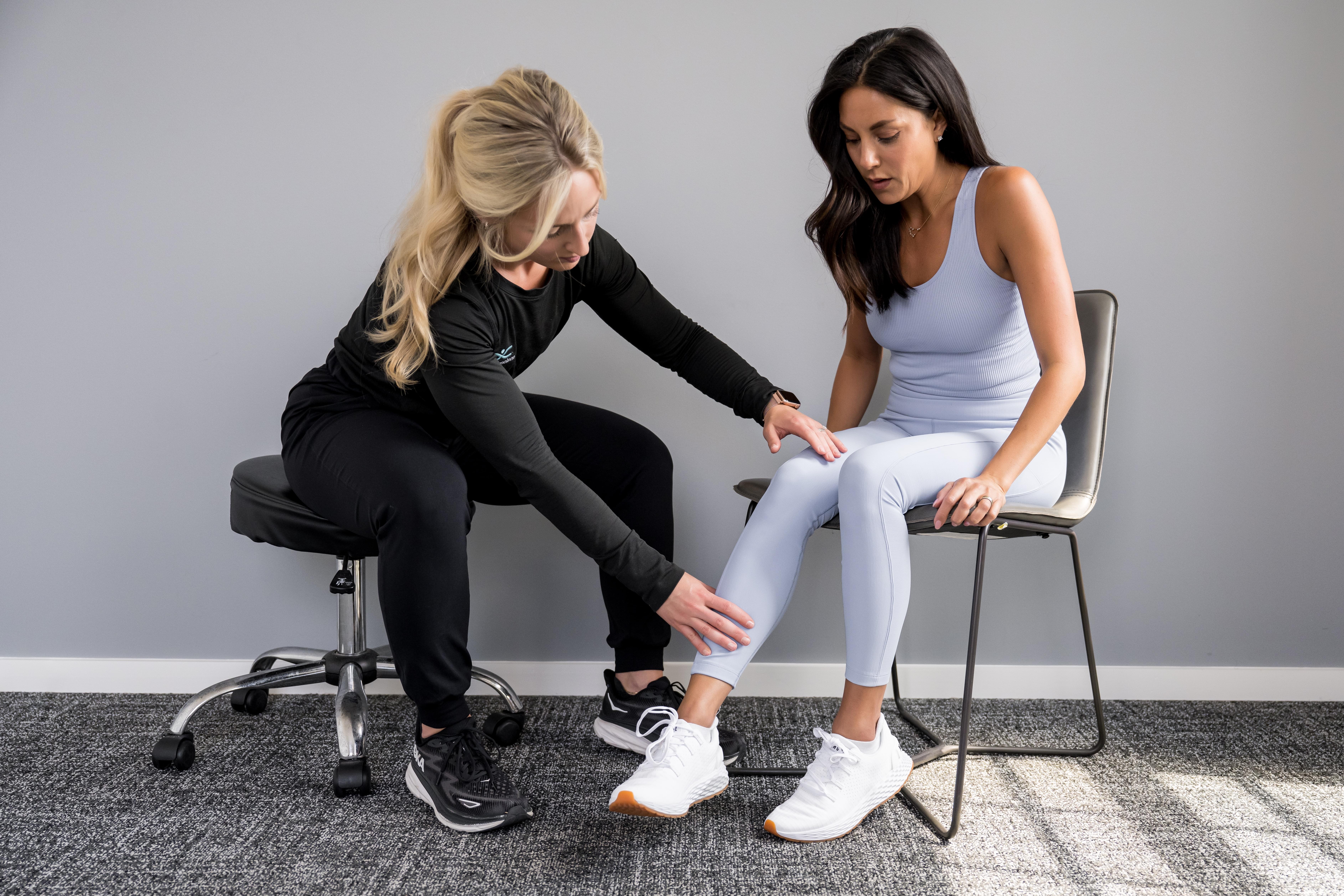
If you’ve been trying stretches or exercises on your own without improvement, it’s worth getting a professional assessment. A chiropractor can:
- Evaluate your posture, gait, and movement patterns
- Identify weaknesses, imbalances, or joint restrictions
- Create a customized treatment plan that combines manual therapy, corrective exercise, and mobility work
Sometimes, even small adjustments, like improving pelvic alignment or restoring ankle motion, can make a huge difference in relieving knee pain.
The Takeaway
Lateral knee pain doesn’t always mean you have a “knee problem.” More often, it’s a movementproblem, a result of the hips and feet not doing their jobs.
When you focus on restoring hip mobility, activating your glutes, and improving the strength and control of your feet, you’re addressing the root cause of your discomfort rather than just masking symptoms.
Your knees are designed to be stable hinges, not shock absorbers. By helping your hips and feet move and function better, you give your knees the support they need to move comfortably and pain-free.
Start Moving Better Today
If you’re struggling with lateral knee pain, don’t wait until it limits your favorite activities. At Integrated Health Solutions, we specialize in helping people identify the true source of their pain and build strength and mobility for long-term results.
Whether you’re a runner, a weekend athlete, or someone just trying to move without pain, we can help you get back to doing what you love, safely and confidently.
Content provided by Dr. Chloe Goodwin