
If you’re reading this, it probably means your knees have been talking to you for a while. Maybe they complain when you bend down to pick something up. Maybe they ache when you walk up or down the stairs. Maybe it’s running, squatting, or even just getting out of the car that makes you wince a little. If you are like many people. You’ve probably shrugged it off and told yourself, “I’m just getting older,” or “I must have stepped funny,” or “It’s not bad enough to do anything about yet.”
As a female chiropractor who uses a mix of soft tissue therapy, adjustments, dry needling with TENS, Dynamic Neuromuscular Stabilization (DNS), and advanced SFMA-based functional rehabilitation, I spend a LOT of time helping people rebuild their relationship with their knees. The truth is: your knees are not weak, fragile, or broken. They’re overwhelmed. They’re compensating. And they’re stuck between two very bossy neighbors: your hips and your ankles.
In this guide, we are going to go over exactly what I do with patients that come in with knee pain. We’re going to break down:
– Why your knees really hurt
– The main types of knee pain and what they often mean
– When knee pain is actually serious
– What I do in the office to help
– DNS and SFMA-based exercises you can start at home
– Lifestyle changes that quickly make everything better
By the end, I want you to feel informed, empowered, and very clear on your next steps.
Why Your Knees Hurt (The Real Story No One Tells You)
Your knees are not actually built to control motion so much as they’re built to allow motion between two areas that should be doing the heavy thinking — your hips and your ankles.
Your hips are the powerful ball-and-socket joints that control rotation, stability, and propulsion. Your ankles connect you to the ground and control how force moves up through your body. Your knees sit in the middle like a hinge, trying to transmit force smoothly from your foot to your hip and back again.
When hips aren’t stable and ankles aren’t mobile, the knees end up doing way more than they were built to do. That’s when pain, irritation, and breakdown begin.
Let’s look at the three biggest contributors: hips, ankles, and your core.
Hip Dysfunction → Knee Pain
If your hip muscles are weak, tight, or poorly coordinated, your femur (thigh bone) can rotate and drift in ways that the knee doesn’t love. You may see your knees cave inward during squats, or notice that when you walk, one leg seems to “fall in” more than the other. Over time, that inward caving can irritate the structures around your knee.
Common hip-related contributors include:
– Weak gluteus medius and minimus (your “side butt” muscles)
– Overactive TFL or tight IT band
– Tight hip flexors from sitting a lot
– Poor control of internal and external hip rotation
– Pelvic imbalances that keep the hip from centering correctly
When your hips aren’t controlling the femur well, your kneecap doesn’t track smoothly, your ligaments are pulled, and your cartilage takes more load than it should.
Ankle Dysfunction → Knee Pain
Now let’s go south to the ankles. Every step you take involves your ankle folding forward, absorbing force, and letting your shin come over your foot. When this is limited, your body gives up, it cheats and finds another way.
And the easiest place for it to cheat? The knee.
If your ankle doesn’t move well, your knee often:
– Juts forward excessively in a squat
– Collapses inward as a compensation
– Feels unstable when stepping off curbs or walking downhill
Often, people with “mysterious” knee pain have very stiff ankles or a history of sprains that never fully recovered.
Core Instability → Knee Pain
This is where DNS comes in strong. DNS is built on the idea that your deep core system — diaphragm, rib cage, and pelvis — drives how your limbs move. If you can’t create internal pressure and control your trunk, your hips don’t stabilize properly, and that instability rolls right down into the knees.
Add in shallow or dysfunctional breathing patterns and your body is constantly compensating. The knees just happens to be where you feel it first.
The Main Types of Knee Pain (And What They Usually Mean)
Knee pain can show up in several different patterns. The location, timing, and type of pain all give us clues about what’s going on underneath.
Patellofemoral Pain Syndrome (PFPS) — “Front of the Knee” Pain
This is the one a lot of runners, stair-climbers, and squatters complain about. The pain is generally around or behind the kneecap and gets worse with:
– Going down stairs
– Deep squats or lunges
– Sitting for long periods (“movie theater knee”)
– Running, especially on hills
PFPS is often linked to how your kneecap tracks in its groove as the knee bends. If the hip doesn’t stabilize well or the ankle doesn’t move properly, the patella gets pulled slightly off-center over and over again. That repeated irritation leads to inflammation and pain.
Medial (Inner) Knee Pain
Inner knee pain shows up a lot when there’s:
– Knee crashing- the knee falls inward due to lack of stability at the hip
– Over-pronated feet (arches rolling inward)
– Hip adductor overuse or tightness
– Irritation of the medial collateral ligament (MCL) or medial meniscus
People with medial knee pain often feel it when they squat, step sideways, pivot, or go down stairs. It’s common in people with weak glutes and unstable hips.
Lateral (Outer) Knee Pain
Lateral pain on the outer side of the knee is often blamed on the IT band. Here’s the truth: the IT band is a thick band of connective tissue — it doesn’t contract by itself. It’s pulled tight by the muscles attached to it.
Outer knee pain can signal:
– Glute medius weakness
– Overactive TFL muscle
– Altered running form
– Hip rotation issues
You’ll often feel this during running, prolonged walking, or side-to-side movement.
Patellar or Quadriceps Tendon Pain
This is usually felt just above or just below the kneecap. It’s often sharper and more localized than PFPS. People describe it as:
– Pain when jumping or landing
– Pain during step-ups or heavy squats
– Stiffness when first standing after sitting
This is a load-tolerance problem. The tendon has been asked to do too much, too soon, without enough support from the rest of the system (hips, hamstrings, calves, and core).
Meniscus Irritation
Meniscal pain isn’t always a catastrophic tear like people fear. It can be irritation or compression from poor mechanics, especially with twisting or deep knee flexion.
You might notice:
– Pain when pivoting
– Discomfort kneeling or fully bending
– Mild swelling after activity
– A feeling of “fullness” or pressure in the joint
Compression-Based or “Stiff” Knee Pain
This one is sneaky. It feels like:
– Stiffness when you bend your knees deeply
– General pressure under the kneecap
– Tightness after sitting or first thing in the morning
Usually, this is not “old age.” It’s a combination of tight quads, tight calves, restricted hips, and poor ankle motion that is compressing the joint more than necessary with each step or squat. The good news? This responds very well to DNS and SFMA corrections.
When Knee Pain Is Serious (And Needs More Than Rehab)
Most knee pain is mechanical and can be helped with the right movement approach. But sometimes, your knee is trying to wave a giant red flag.
You should seek prompt medical evaluation if:
– You heard or felt a pop followed by immediate instability.
– Your knee ballooned with swelling within the first hour after injury.
– You cannot put weight on the leg without significant pain.
– The knee locks or gets stuck and you can’t straighten it.
– The knee is red, very warm, and you have a fever (this can indicate infection).
– You’ve had significant trauma (fall, car accident, sports collision).
Those are not “wait and see” situations — they are “be seen now” situations.
What I Do In the Office (Step-by-Step Approach)
If you walked into our clinic and told me your knees hurt when you squat, bend, walk, or run, here’s how I’d approach you.
Using a combination of SFMA and orthopedic tests, Range of motion testing and palpation; I’d assess which muscles are overworking and which ones are underperforming. Then I would use the following:
-Dry needling allows me to get deep into muscles that your hands can’t quite access in the same way. I commonly needle:
– VMO and other quadriceps points
– TFL and glute med
– Calf trigger points
-Gluteus medius
– Fibularis along the lower leg
-Then I’d use soft tissue therapy techniques to reduce tension and improve tissue quality in areas like:
– Quadriceps (especially rectus femoris and VMO)
– TFL and proximal IT band
– Glute max and glute med
– Adductors (inner thigh muscles)
– Hamstrings
– Calf complex (gastroc and soleus)
-For restricted segments I would use chiropractic adjustments to restore motion.
Adjustments help restore normal motion and alignment, which changes how force is distributed across the knee during movement.
-Finally, rehabilitation will retrain the nervous system and help your body begin to stabilize and move correctly. This makes a long term change that heals and helps prevent future injury. At IHS, we use DNS and SFMA style exercises to have better and long lasting results. We focus on:
– Diaphragmatic breathing
– Pelvis neutrality
– Joint centration
– Smooth, controlled limb movement
When this system is working well, your knees naturally track more cleanly and hurt less with daily movements.
DNS + SFMA-Based Exercises You Can Start at Home
Here are some of the advanced-style exercises I give my knee pain patients that you can try at home. These are not random stretches; they are intentional, integrated movements.
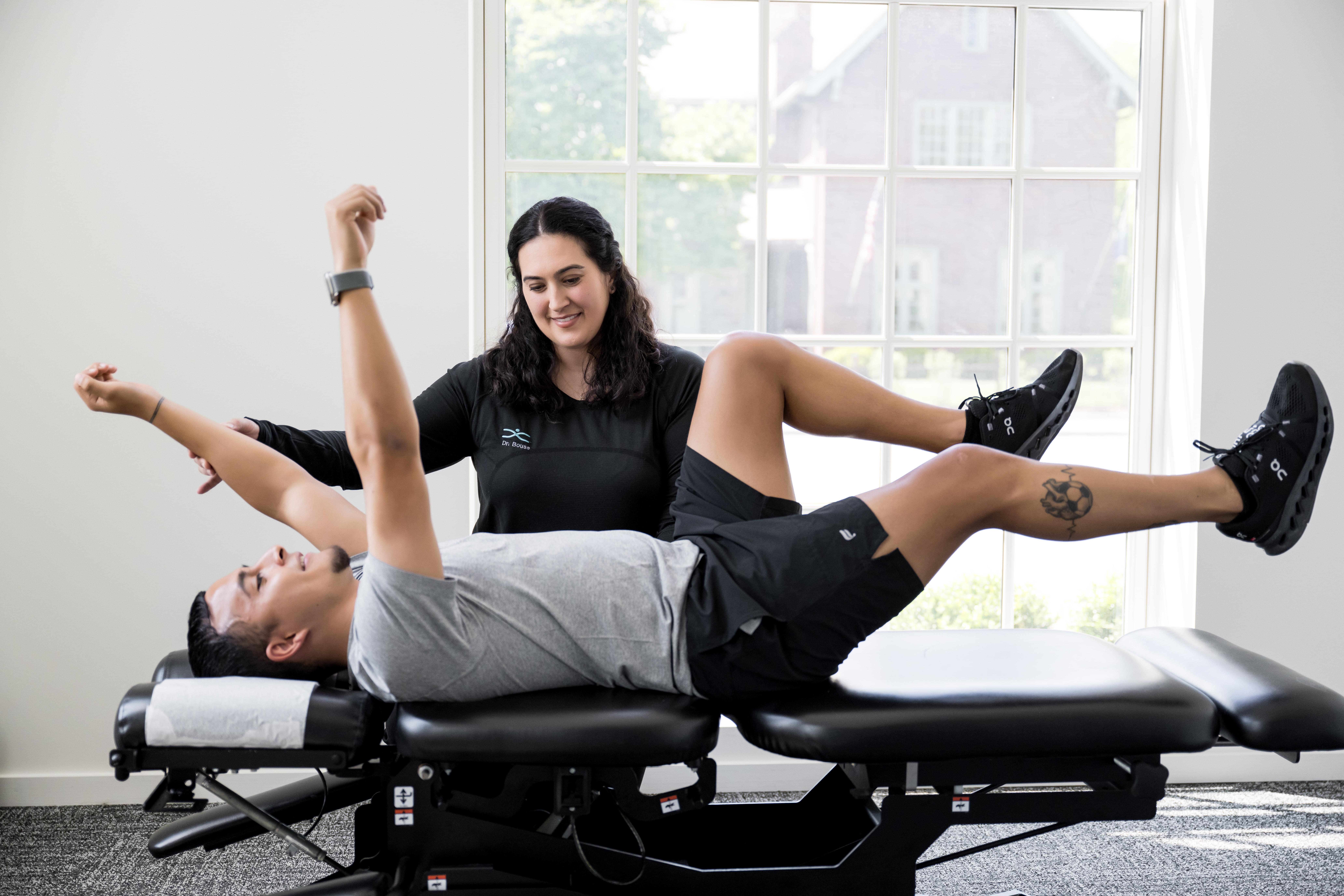
DNS 3-Month Supine Position with Alternating Leg Lift-Offs
Purpose:
To reconnect rib position, breathing, core stability, and hip control.
How to:
– Lie on your back with your hips and knees bent to 90 degrees.
– Place your feet on a wall or chair so your shins are parallel to the floor.
– Gently draw your ribs down so your spine is neutral, not arched.
– Inhale through your nose and feel your lower ribs expand sideways.
– As you exhale, slowly lift one foot off the support just an inch or two.
– Keep your pelvis still and your ribs stacked.
Reps: 8–10 per side, 2–3 sets
DNS Side-Sitting Hip Flexibility
Purpose:
To restore healthy internal and external rotation at the hip, which protects the knee from torsional stress.
How to:
– Sit on the floor with one leg bent in front of you and the other bent behind you (a “Z” shape).
– Sit as tall as you comfortably can, ribs stacked over pelvis.
– Slowly rotate your torso toward your front leg, then slowly rotate toward your back hip, keeping your pelvis as level as possible.
Breathe deeply in the position and try to maintain upright posture for 60seconds.
SFMA Ankle Dorsiflexion Mobilization
Purpose:
To increase ankle mobility so your knee doesn’t have to compensate as much.
How to:
– Stand facing a wall with one foot about 3–4 inches back.
– Keeping your heel flat, gently drive your knee toward the wall.
– Don’t let your arch collapse — keep the foot tripod grounded.
– Move in and out of the stretch rhythmically.
Reps: 12–15 each side, 2–3 sets
Lifestyle Shifts That Quietly Help Your Knees Every Day
While hands-on care and exercises are crucial, your day-to-day habits can either support your progress or sabotage it.
Helpful habits include:
– Choosing shoes with proper support instead of worn-out, flat, or unsupportive footwear.
– Avoid locking your knees when you stand; keep a soft, gentle bend.
– Warming up hips and ankles before runs or leg workouts.
– Breaking up long sitting periods with short movement “snacks.”
– Including glute and hamstring strengthening in your weekly routine.
– Walking on softer surfaces like tracks or trails when you can, especially if you’re already sore.
These aren’t dramatic changes, but together they reduce the daily stress on your knees and complement all the rehab work you do.
Your Knees Aren’t Old — They’re Asking for Better Movement
Here’s what I want you to walk away with: your knee pain is not a random punishment, a sign you’re too old, or proof that you’re broken. It is information.
It’s your body saying:
“Hey, something about the way we’re moving, stabilizing, or loading isn’t working for me.”
When we listen to that information, use tools like DNS and SFMA to understand where the real problem lives, and then support your body with the right mix of soft-tissue work, adjustments, dry needling, corrective exercise, and smart daily habits, your knees can absolutely feel stronger, more stable, and less painful. If you’re struggling with similar symptoms, we’re here to help. Schedule a visit today so we can help you get back to feeling your best.
Content provided by Dr. Elizabeth Bouse