
You know that feeling—rolling out of bed in the morning, joints creaking like your childhood chain-swing set, dragging a little trying to get started. You shrug. “Eh, I’m just getting old.”
Right?
Maybe you tell yourself the same thing: that the achy knee, or the tight shoulder, or the stiff hip is simply a badge of time passing. After all, you did “a lot” this summer (or always do), and besides—everyone your age complains of something, right?
Here’s the thing: yes, the body changes with age. But no, not everything is just “getting old.” Sometimes it’s your body waving a red flag you’re wise to listen to. At Integrated Health Solutions—your local chiropractic rehabilitation center serving Carmel, Fishers, and Indianapolis—we see plenty of patients who told themselves the same story… only to find out there was something more going on. And once the real issue was addressed, they got their
spring back.
In this blog, we’ll walk through how to tell the difference between “normal aging” joint changes and something that deserves your attention—especially if you’re looking into a Chiropractor in Carmel IN, Chiropractic Carmel IN, Chiropractor Carmel Indiana (or Fishers or Indianapolis) for help. We’ll cover what’s actually “okay,” what’s not, how our exams work, real-life success stories, and holistic strategies you can use now. Because “just getting old” doesn’t have to mean “just hurting more.”
When Pain Is Not Normal Aging
“Is joint pain just aging?”
That’s a question we hear all the time. And the subtle answer is: Sometimes. Let’s unpack this.
What aging tends to do
As you age, your joints change. Cartilage gradually wears down, the fluid lubrication might reduce, and you may get a little more stiffness in mornings or after long inactivity. According to the Cleveland Clinic, osteoarthritis—the most common type of arthritis that comes with wear-and-tear—“develops slowly and usually occurs after age 45.”1 You may feel a grating, creaking, or some stiffness with movement.
But: the key words are slowly, gradually, often manageable. Think “I slept weird and my hip’s a little off,” not “I can’t walk up the stairs without stopping.”
What should raise eyebrows
Here’s when the “it’s just aging” excuse doesn’t hold well:
- Persistent or worsening pain instead of occasional ache. According to the Mayo Clinic, you should see a provider if you have joint pain along with swelling, redness, warmth, fever—or if the joint looks “out of shape” or you can’t use it.2
- Joint pain that starts limiting your life—walking upstairs hurts, your shoulder won’t lift the grocery bag, you stop playing with your kids/grandkids because you’re “too sore.”
- The stiffness doesn’t improve with movement (or actually worsens)—aging joints tend to loosen up a bit as you move, not get locked down.3
- If you have previous injuries (like from a car accident, sports injury, repetitive strain) or you’ve been overusing a joint—those raise risk.
- Night pain. Pain that wakes you up, or keeps you up: that’s not just “older joints” saying, “Hey, I’m here.” It’s more like “Hey, we’ve got a problem.”
So yes: aging can bring changes, but if your joints are sending emergency signals, they deserve more than a shrug.
Red Flags That Require Attention
“When should I see a doctor for joint pain?”
Glad you asked. You shouldn’t just “live” with joint pain and assume it’s no big deal. As the Northwestern Medicine put it: “your body could be trying to tell you something.”2
Here are the red-flags that we at Integrated Health Solutions pay very close attention to:
- Sudden or unexplained swelling, redness, warmth around a joint.
- Deformity of the joint (it looks odd, misaligned, or you notice a visible change).
- Inability to bear weight on a leg or foot, or inability to use the joint like you used to (stairs, walking, etc.).
- Pain that doesn’t improve with rest, or actually keeps getting worse. According to one source, if pain lasts more than a few days with light activity and doesn’t ease up, you’ve got early warning signs.7
- Grinding, locking, catching sensations in the joint. That “pop” is not just old age—could be cartilage or structural trouble.
- Night pain or pain at rest. Rest is supposed to help—not make it worse.3 History of trauma or injury (especially from a car accident or auto-injury) or repetitive stress (work, sport) that may have set the stage.
- Other systemic signs: fever, unexplained weight loss, multiple joints involved without explanation—these might point to inflammatory or autoimmune conditions.1
Why urgent attention matters
Because when something underlying is going on—whether it’s early osteoarthritis, tendon/ligament damage, or post-injury joint dysfunction—early diagnosis means better outcomes. Some joint issues become worse over time unless addressed. For instance, the blog from Orthopedic Specialists of Jacksonville says: “[Pain] that becomes persistent, disrupts sleep, or limits your daily movement… could be more than a natural part of aging.”6
So, if you’re thinking “it’ll just go away,” know: it might, but it also might not—and you could end up in a more restricted place later.
What Our Exams Uncover at Our Chiropractic Rehabilitation Center
“What does a chiropractor look for when I come in?”
At Integrated Health Solutions (with convenient locations in Carmel, Fishers, and Indianapolis), our approach is holistic. When a patient comes in saying “my shoulder hurts,” “my knee’s stiff,” “my hip bothers me”—we don’t assume it’s just age. We ask, we observe, we test—and we treat.
Here’s what we dig into:
a) History & Context
We ask:
- How long have you had the pain? Did it start gradually or suddenly?
- Did something trigger it (injury, fall, car accident, repetitive motion)?
- Is it getting better, worse, or staying the same?
- What’s life like for you day-to-day: work, hobbies, movement?
- Any other symptoms (swelling, heat, grinding, inability to move, sleep disturbance)?
- What helps or hurts? Morning or evening worse? After rest or after activity?
- Was there any past accidents or major injuries?
This matters—because someone in their 50’s with gradual stiffening may have one thing; someone in their 30’s who had a vehicle collision may have a totally different cause (accident and injury chiropractor side of things applies).
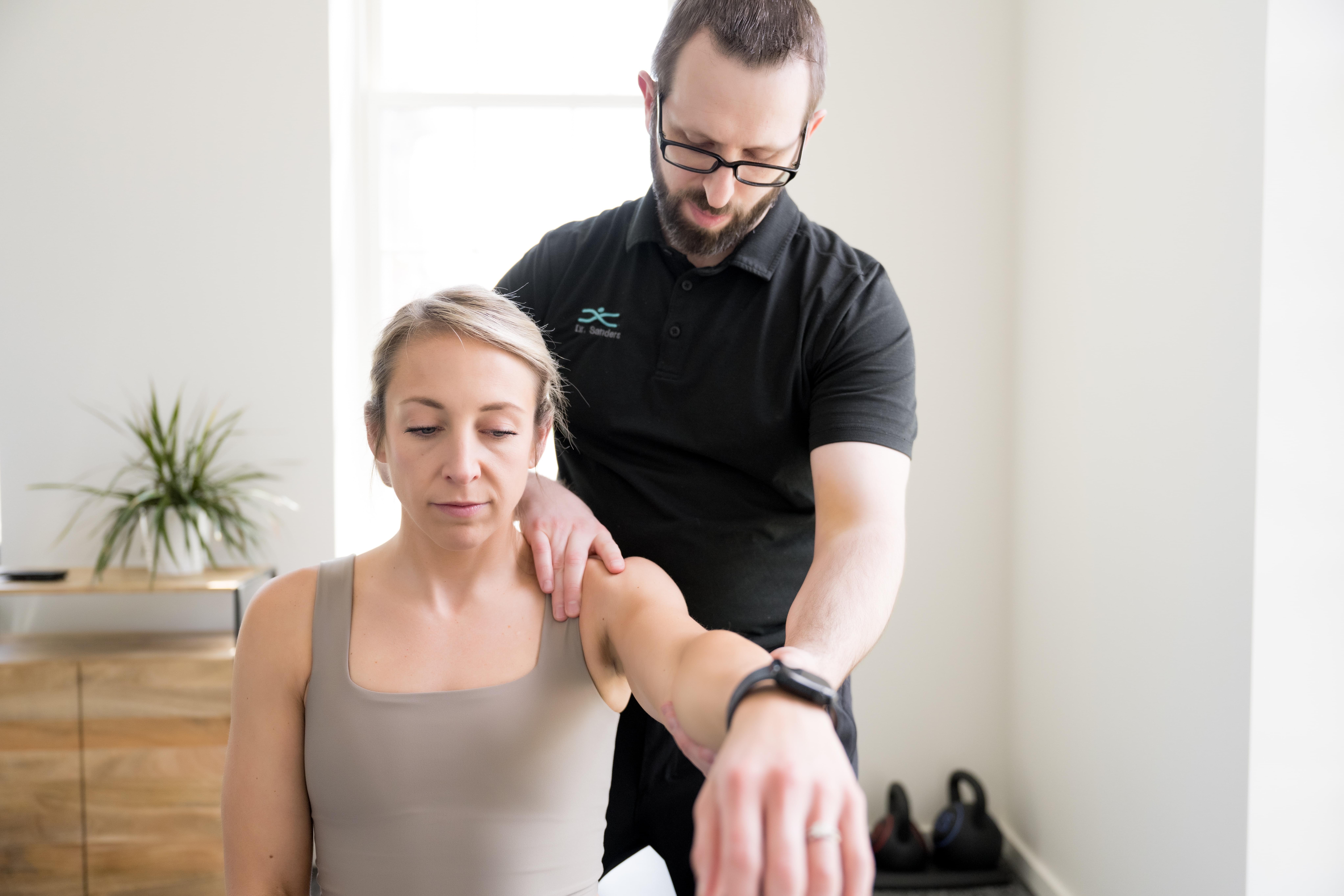
b) Physical Exam & Functional Movement
We check not just the joint itself, but:
- Range of motion: can you move it fully? Are there restrictions?
- Strength &-support: how are the muscles around the joint—weak, tight, imbalanced?
- Joint stability: any “sloppy” feel? Does it lock or catch?
- Movement patterns: how do you walk, sit, stand, lift? Is the joint being forced into awkward positions repeatedly?
- Posture and spinal alignment (yes, even for knees/hips—your spine and pelvis set the stage for joint load).
- Specific tests for ligaments/tendons/cartilage as needed (based on exam cues).
- We utilize Selective Functional Movement Screens to test a lot of these along with stability of moving patterns that correlate to activities of daily living.
c) Imaging & Diagnostics (if needed)
With our chiropractic rehabilitation framework, many issues respond well to non-surgical intervention—but we also know when to refer. If the exam suggests something structural (cartilage damage, ligament tear, previous trauma, joint degeneration) we may recommend:
- X-ray to assess bone alignment, joint space, spurs.
- MRI if soft tissue or cartilage damage is suspected.
- Movement-/gait-analysis.
- Referral to orthopedist/rheumatologist if systemic/complex disease is suspected.
d) Treating the Underlying Cause (Not Just the Symptom)
Rather than simply telling you “take NSAIDs and rest,” we use an integrated approach:
- We start with Soft-tissue therapy: reducing compensatory tightness in muscles, fascia that are contributing to abnormal joint stress. To do this we utilize dry needling to induce a small degree of tension in the tissue to help improve vascularization and reconstruction of the tight tissue. We follow that up with a myriad of myofascial release techniques that include but are not limited to “sport” massage, graston, nimmo, active release technique, PNF, and much more.
- Manual chiropractic adjustments and joint mobilization: improving joint mechanics and reducing abnormal load.
- Therapeutic exercises: building strength, flexibility, balance around the joint.
- Movement retraining and stability re-education: so your body moves more efficiently with proper stabilization that doesn’t put undue stress on one joint.
- Injury rehabilitation (especially if you’ve had a car accident, auto-injury, or repetitive strain).
- Lifestyle & nutrition guidance: factoring in weight, inflammation, movement habits.
- Monitoring progression: joint health isn’t a one-time fix—it’s an ongoing conversation.
So, in short: we uncover why the joint is hurting (age + wear + load ? injury from a car accident ? misalignment + muscle weakness ?) and then build a plan. And yes—in Carmel, Fishers, Indianapolis we’re set up for this.
How We Manage Aging Joints Holistically
“How can I help my joints — without just taking pain-killers?”
Great question. The good news: you have more control than you think—and the right approach can help you move well and feel better for years to come. Our multi-modal process covers:
Movement & Strength
- Low-impact aerobic work: swimming, cycling, walking—keeps joints lubricated, cartilage nourished. The Cleveland Clinic emphasises that exercise helps even after 45.1
- Strength training: muscles offload joints. If your muscles are weak, the joint absorbs more stress.
- Mobility & flexibility: tight muscles pull joints into bad positions.
- Movement quality: how you move matters—walk, lift, twist with good mechanics, not on autopilot.
Alignment & Joint Mechanics
- Spinal and pelvic alignment influence hips, knees, shoulders.
- Chiropractic adjustments + joint mobilization help improve how the joint moves.
- Soft tissue work: to release compensatory tightness (think IT-band, hip flexors, pecs).
- Ergonomic/postural review: your desk job, driving posture, running, lifting kids—all matter.
Load Management
- Modify high-impact activities if needed: repeated pounding may accelerate wear.
- Recovery strategy: rest, sleep, anti-inflammatory food pattern, movement variety.
Nutrition & Inflammation Profiling
- Consider anti-inflammatory foods: omega-3 rich fish, berries, leafy greens.
- Hydration matters—cartilage needs water too.
- Your chiropractor can coordinate with other providers for supplements if needed (though we don’t prescribe medication).
Injury & Crash History
- If you’ve been in a car accident (auto injury chiropractor), had a fall, or repetitive sports/work strain—these set the stage for premature joint failure.
- We integrate rehab for those prior injuries so they don’t silently drive joint degeneration.
Lifestyle Integration
- Sleep quality influences healing (poor sleep = more pain, less recovery).
- Stress management: chronic stress elevates inflammatory tone.
- Be active in life: hobbies, social engagement, movement—these all reinforce healthy joints.
Monitoring & Maintenance
- Because aging joints might need ongoing care rather than a one-and-done fix.
- Regular check-ups: posture, movement, strength, alignment.
- Adapt plan as your life changes (job demands, family demands, hobbies, even seasons).
Pulling It Together: You Don’t Have to Live With It
Let’s wrap up. If you’re reading this and thinking:
“Yeah, I have that hip I ignore,”
or
“My knee’s been clicking for months,”
or
“I keep telling myself I’m just getting old,”
I have three simple take-aways for you:
- Don’t dismiss the pain. Aging is real—but pain is your body’s language. If it’s persistent, worsening, waking you up, limiting you, or following a trauma (like a car accident)—it deserves examination.
- Get evaluated by a professional who sees the chain, not just the joint. At Integrated Health Solutions we address spine-pelvis-joint-muscle, movement patterns, and you get a plan, not just an adjustment. We serve Carmel, Fishers, Indianapolis—so if you’re looking for a Chiropractor in Carmel IN, Chiropractor Fishers Indiana, Indianapolis Chiropractor, we’ve got you.
- Act early. The sooner you identify and address the root cause, the better your outcomes. Whether it’s injury-driven, wear-and-tear, misalignment, or overuse—it’s more treatable in the earlier stages.
At Integrated Health Solutions, your joint health matters. You don’t have to resign to “this is just aging.” With the right partner, the right assessment, and the right plan, you can move better, feel better, and enjoy your life without the constant “I hope this doesn’t hurt today” mindset.
If you’ve been saying to yourself, “I guess this is just my body getting older,” let’s challenge that together.
Don’t let joint pain quietly steal your quality of life. Whether you’re seeking a Chiropractor Carmel Indiana, Chiropractor in Fishers IN, or Indianapolis Chiropractor, give us a call at Integrated Health Solutions. We’ll help you uncover the real cause of your pain—not just treat the symptom. Because getting older doesn’t mean you have to get worse. Schedule your evaluation today and take the first step toward moving freely and feeling strong again.
Content provided by Dr. Andrew Sanders