
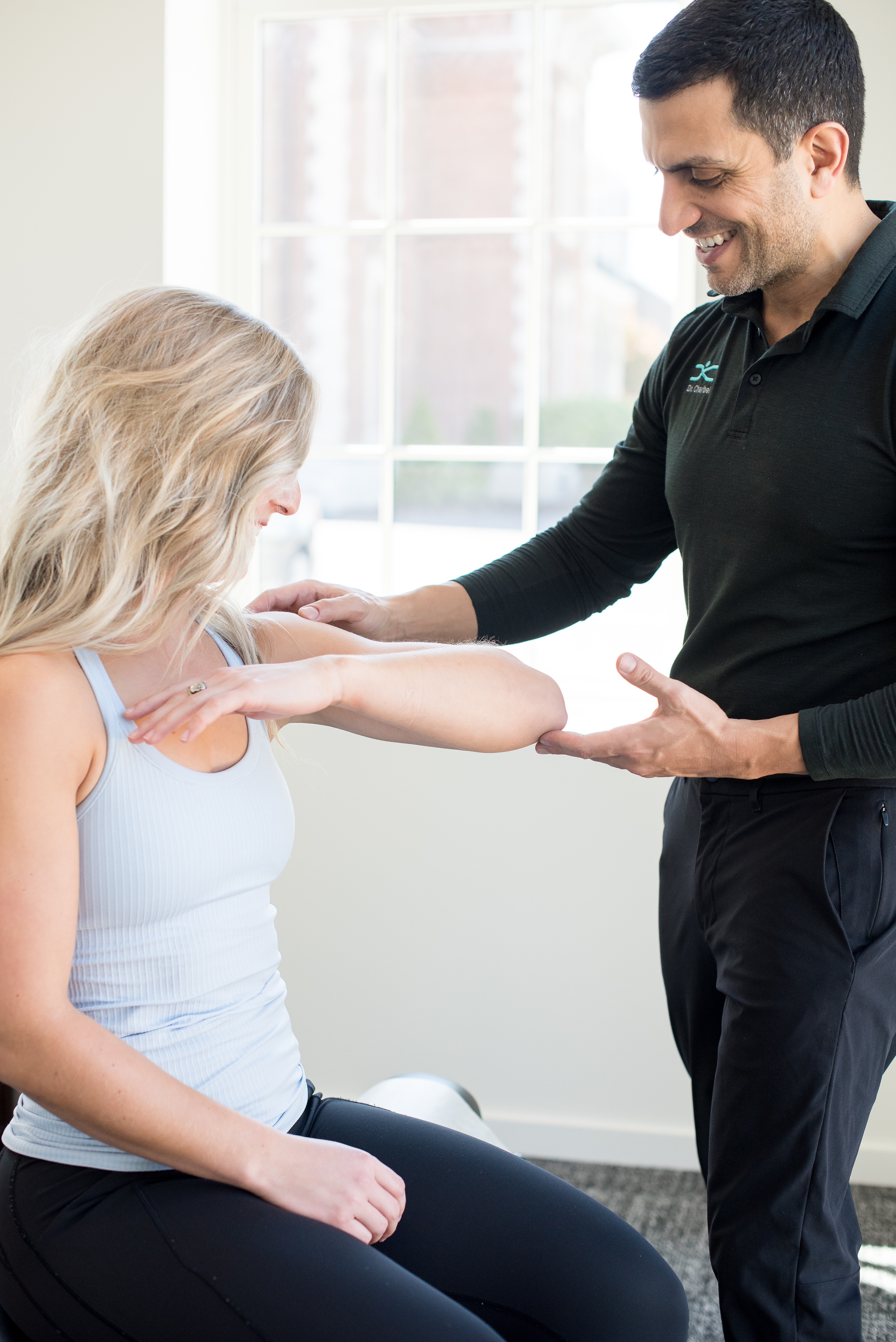
If you’ve ever experienced a sharp pain on the outside of your elbow while lifting a coffee cup, shaking someone’s hand, or swinging a tennis racquet, you’re not alone. Despite its name, tennis elbow affects far more people than just tennis players. In fact, most cases occur in individuals who have never stepped onto a tennis court.
As a chiropractor, one of the biggest misconceptions I hear is that tennis elbow is simply an “elbow problem.” While the pain is certainly located around the elbow, the root cause often extends much further up the kinetic chain. The muscles of the forearm, the strength and stability of the shoulder, and even the way the neck and upper back move all influence how force is distributed through the arm.
Rather than focusing solely on reducing pain, my goal is to identify why the tissues became overloaded in the first place. By improving load distribution throughout the entire upper extremity, we can not only reduce symptoms but also help lower the risk of the problem returning.
What Is Tennis Elbow?
Tennis elbow, also known as lateral epicondylalgia or lateral epicondylitis, is an overuse injury involving the tendons that attach to the outside of the elbow. These tendons connect the wrist extensor muscles of the forearm to the lateral epicondyle of the humerus.
Although the condition is often referred to as “tendonitis,” research has shown that many chronic cases involve degenerative changes within the tendon rather than ongoing inflammation. The tendon gradually loses its ability to tolerate repetitive stress when the demands placed upon it exceed its capacity to recover. This results in pain, reduced grip strength, and difficulty performing both athletic movements and everyday activities.
Many patients first notice discomfort while lifting objects, opening jars, using tools, typing, or even carrying groceries. As the condition progresses, pain may begin to interfere with simple daily tasks that once seemed effortless.
Why Does Tennis Elbow Develop?
While repetitive movement certainly plays a role, tennis elbow is rarely caused by repetition alone. The underlying issue is often poor load management throughout the upper extremity.
Every time you grip, lift, type, swing a racquet, or use hand tools, your forearm muscles generate force. When these muscles are repeatedly asked to absorb more stress than they can recover from, the tendon eventually becomes irritated. This process may occur gradually over weeks or months without a single obvious injury.
Several factors contribute to this overload, including sudden increases in activity, repetitive gripping, poor lifting mechanics, prolonged computer work, inadequate recovery between workouts, and weakness throughout the shoulder complex. In many cases, patients are surprised to learn that their elbow pain is actually influenced by movement patterns occurring much farther up the arm.
Rather than simply asking why the elbow hurts, I focus on understanding why that tendon is consistently being overloaded. Identifying the source of excessive stress allows us to create a treatment plan that addresses both the symptoms and the underlying cause.
Why the Shoulder Plays an Important Role
One of the most overlooked contributors to tennis elbow is shoulder function.
The shoulder serves as the stable foundation from which the arm produces movement. If the muscles surrounding the shoulder blade and rotator cuff are weak, fatigued, or poorly coordinated, the forearm must compensate by working much harder during everyday tasks.
Think of it like building a house. If the foundation becomes unstable, the rest of the structure has to absorb forces it was never intended to handle. The same principle applies to the upper extremity. When the shoulder is not effectively controlling movement, the smaller muscles of the forearm often become overloaded.
Interestingly, many patients have perfectly pain-free shoulders yet still exhibit weakness, reduced endurance, or poor motor control. They often don’t realize their shoulder is contributing to the problem until strength testing reveals significant deficits.
Improving shoulder strength and stability helps distribute force more evenly across the entire arm. Instead of relying almost entirely on the wrist extensor muscles, the body begins sharing the workload more efficiently, reducing unnecessary stress on the injured tendon.
Understanding Load Distribution
One of the most important concepts I teach patients is load distribution.
Every movement your body performs requires force to travel through multiple joints, muscles, and tendons. Ideally, that force is shared efficiently throughout the entire kinetic chain. When one area becomes weak, stiff, or poorly coordinated, another area is forced to compensate.
For example, a carpenter who grips tools throughout the day, a tennis player with poor shoulder mechanics, or an office worker spending hours on a computer mouse may all develop the same condition for different reasons. Although the activities differ, the common denominator is excessive loading of the forearm tendon.
Improving how force is distributed throughout the arm often produces better long-term results than focusing exclusively on the painful elbow itself.
A Comprehensive Chiropractic Approach
Successful treatment rarely depends on a single intervention. Instead, I view recovery as a combination of reducing pain, restoring movement, rebuilding strength, and gradually increasing tissue capacity.
Every patient presents differently, which is why treatment plans are individualized. However, most comprehensive rehabilitation programs combine dry needling, soft tissue therapy, chiropractic adjustments, progressive strengthening exercises, and education regarding activity modification.
Each component addresses a different aspect of the recovery process, and together they create an environment that supports healing while reducing the likelihood of future recurrence.
Dry Needling
Dry needling has become an effective tool for many patients experiencing tennis elbow, particularly when significant muscle tightness exists throughout the forearm.
The wrist extensor muscles frequently develop painful trigger points that contribute to reduced function and increased discomfort during gripping activities. Dry needling can help decrease muscle tension, reduce pain sensitivity, improve circulation within the muscle, and allow patients to participate more comfortably in rehabilitation exercises.
It is important to recognize that dry needling is not intended to heal the tendon by itself. Instead, it serves as an adjunct treatment that often reduces discomfort enough for patients to actively participate in the strengthening program that ultimately drives long-term improvement.
Soft Tissue Therapy
Soft tissue therapy also plays an important role throughout rehabilitation.
Whether utilizing myofascial release, instrument-assisted soft tissue mobilization, trigger point therapy, or other manual techniques, the objective is not to “break up scar tissue,” but rather to improve tissue mobility, decrease muscle guarding, and reduce sensitivity.
Many patients notice improved flexibility, less forearm tightness, and greater comfort during gripping activities after treatment. These changes often make it easier to perform the exercises necessary for rebuilding tendon capacity.
Hands-on treatment alone rarely provides lasting recovery, but when combined with progressive strengthening, it becomes a valuable component of the rehabilitation process.
Rehabilitation Exercises: The Foundation of Recovery
While passive treatments can help reduce symptoms, rehabilitation exercises remain the cornerstone of successful tennis elbow management.
Tendons heal by adapting to carefully prescribed mechanical loading. Appropriate exercise stimulates collagen remodeling, improves tendon strength, and gradually increases the tissue’s ability to tolerate everyday demands.
Early rehabilitation often focuses on gentle movement and isometric exercises that reduce pain while maintaining muscle activity. As symptoms improve, resistance is gradually increased through wrist extension strengthening, eccentric loading, forearm rotation exercises, grip strengthening, and progressive resistance training.
Eventually, rehabilitation transitions toward functional activities that mimic the patient’s work, sport, or recreational demands. Whether someone is returning to construction work, tennis, golf, CrossFit, or simply lifting grandchildren, rehabilitation should prepare the body for those specific movements.
The goal is not merely eliminating pain but creating a tendon capable of handling future stress without recurring symptoms.
Why Chiropractic Adjustments Can Help
Many people wonder how chiropractic adjustments fit into the treatment of tennis elbow.
Although the injured tendon is located at the elbow, the joints of the wrist, shoulder, neck, and upper back all influence movement throughout the upper extremity. Restricted motion within these areas can alter mechanics and contribute to excessive stress on the forearm.
Chiropractic adjustments are intended to restore normal joint motion where restrictions are present. Improved mobility may enhance overall movement quality, reduce discomfort, and help patients move more efficiently during both daily activities and exercise.
Adjustments are not a stand-alone treatment for tennis elbow, but they can be a valuable part of a broader rehabilitation strategy that also includes manual therapy, exercise, and patient education.
Staying Active While Healing
One of the biggest misconceptions surrounding tennis elbow is that complete rest is necessary for recovery.
While reducing aggravating activities may be appropriate during periods of significant pain, prolonged immobilization often delays recovery because tendons require mechanical loading to remain healthy.
The key is identifying an appropriate level of activity that challenges the tendon without overwhelming it. This may involve temporarily reducing exercise volume, modifying work tasks, improving lifting technique, or making ergonomic adjustments while gradually rebuilding strength.
Finding the right balance between protection and progressive loading is one of the most important factors in successful rehabilitation.
Preventing Tennis Elbow from Returning
Recovering from tennis elbow is only part of the process. Preventing recurrence requires continuing many of the habits developed during rehabilitation.
Maintaining forearm and shoulder strength allows the body to distribute force more efficiently during repetitive activities. Gradually increasing training intensity, warming up before exercise, using proper technique, and addressing mobility restrictions before they become problematic all contribute to long-term tendon health.
Rather than waiting until pain returns, maintaining strength and movement quality helps create a more resilient upper extremity capable of handling the demands of work, sport, and everyday life.
Final Thoughts
Tennis elbow may present as pain on the outside of the elbow, but successful treatment often extends far beyond the painful area itself.
As chiropractors, we recognize that the elbow functions as part of an interconnected movement system. When the forearm becomes overloaded because of weakness, poor movement patterns, reduced shoulder stability, or restricted mobility elsewhere in the upper body, treating the elbow alone may provide only temporary relief.
A comprehensive treatment plan that incorporates dry needling, soft tissue therapy, chiropractic adjustments, progressive rehabilitation exercises, and shoulder strengthening addresses both the symptoms and the mechanical factors contributing to excessive tendon stress.
Healing takes patience, consistency, and an individualized approach. When treatment focuses on improving load distribution throughout the forearm, shoulder, and upper body, patients are often able to regain strength, return confidently to the activities they enjoy, and reduce the likelihood of future flare-ups.
Ultimately, the objective is not simply eliminating elbow pain. It is creating a stronger, more resilient body that can tolerate the demands of daily life, work, and sport for years to come.
Content Written By: Dr. Chloe Goodwin